Cisco’s Liz Centoni To Partners: ‘IQ Is Your New Profit Engine’ In The AI Era
Just in time for Cisco Partner Summit 2026, Cisco EVP and chief customer experience officer Liz Centoni outlines how Cisco is helping partners turn AI into recurring revenue through Cisco IQ, why many AI projects fail to reach production, and how the company’s open, platform-based approach is driving customer outcomes.

Cisco has spent much of this year putting AI-driven services and partner profitability at the center of its channel strategy. A key piece of that effort is Cisco IQ, the now generally available AI-powered digital interface that brings together Cisco's support and professional services capabilities into a single platform designed to help partners identify risk, automate lifecycle management and create recurring revenue opportunities.
Ahead of Partner Summit 2026, Cisco executive vice president and chief customer experience officer Liz Centoni (pictured) says AI-powered services, open integrations and proactive customer lifecycle management are becoming the next major growth opportunity for the channel.
In this exclusive Q&A, Centoni discusses how Cisco IQ can help drive partner profitability and differentiation, why many AI projects struggle to move beyond pilot phases, what Cisco means by its "Switzerland of AI" strategy, and how the company is using AI across customer support, services and operations.
Here are excerpts from the conversation.
Cisco keeps talking about helping partners monetize AI. Beyond the hype, what are the biggest AI-driven revenue opportunities for partners today, and how does Cisco IQ help create recurring revenue opportunities?
If you think about the opportunity for partners with CX and how partners can drive revenue with services and support, let's talk about the first one. High-margin services; especially in a post-Mythos world, where customers are looking at risk, part of the branded services that you can build on top of IQ drives 54 percent of their revenue and 73 percent of margin for our top partners. Cisco IQ eliminates manual scoping, so partners can scale these services a lot more profitably. So, it is delivering the opportunity as well as the margins for them.
The second one is: How do you take the insights that you get from an AI-driven engine like Cisco IQ and turn it into a billable service? You have automated assessments outside understanding vulnerabilities in customers' environments and last day of support. You have priority bugs, software conformance, the operating system upgrade readiness. We're taking this telemetry and making it a funded modernization engagement because our customers have to modernize their environments both to be able to run AI workflows as well as protect them against AI-enabled attacks.
The third thing is more around the economics of it. We have deal registration and DSA eligibility that ensures partners who identify and develop the lifecycle opportunities keep their margins protected as well. So, I would say the opportunity is manyfold.
I can tell you a customer that we'll talk about at Partner Summit said their security advisory response was cut from four days to 10 minutes across 11,000 devices. That's huge at a time when it's really around ‘How do you use the machine to respond to machines when they get attacked?’ because using humans to respond to machines is a lot harder. That's just around security attacks. We have another customer whose support tickets were down 10 percent, and their network reliability productivity was up 25 percent. These are the things where it's how we're using AI-enabled capabilities, both in terms of helping our customers' resilience, plus keeping the network up and running. It's helping partners identify opportunities, and not just a one-and-done, but a continuous recurring revenue motion.
What we're doing in a post-Mythos world is a recurring motion. It's not a ‘let me come in and assess your environment [and] assess the risk.’ It's something that we have to continue to do, working with our customers and our partners, and that recurring contracted revenue creates an EBITDA multiplier for them. What we used to have before, the one-and-done, does not create that EBITDA multiplier. Then, if you take our incentive structures along, every step of the journey now brings that return for a partner.
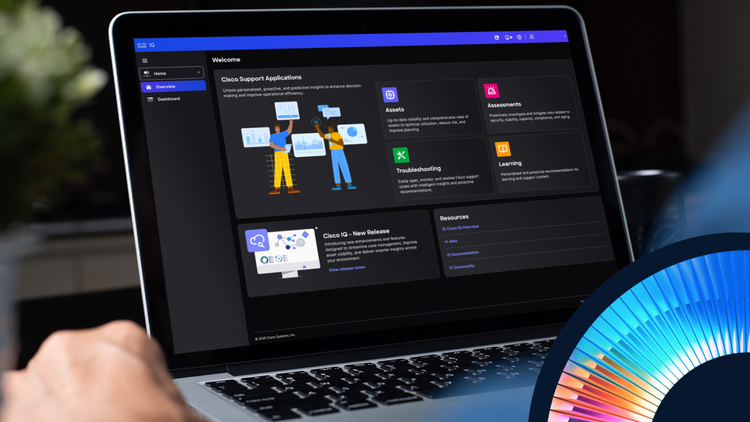
Many enterprises are still stuck in AI pilot mode. What has Cisco learned about moving AI initiatives from pilot to production?
If I look at how pilots go to production versus pilots going into graveyards, what fails is laying AI onto broken workflows, and we found this out ourselves because when you layer AI on top of an existing legacy process, it just makes a broken experience go faster and it doesn't improve anything. Small pilots stall because companies treat AI as an add-on, rather than doing the hard work around redesigning a workflow because workflow surgery is hard to do. I would say that's the first one. To move something from pilot to production, you have to look at the workflow. You have to treat the user as part of the technology stack.
And speaking about the user being part of the technology stack, the constraint is not the model. It's not the infrastructure. It's the human feedback loop. Because what we found is that when we launch agents, it's very different from building software that's 100 percent there. You develop it, you test it, you put it into production. When you do agents, it's 60 percent of the capability, and you reach 90 percent-plus of the capability where you're making it usable at scale. You can only do that when users are treated as part of the tech stack, and they feel safe about giving honest feedback rather than performing compliance, like, ‘Oh yes, I adopted it,’ and nothing changes.
I would say for us, when we did this in our professional services, and even in our renewals organization, where 40 percent of the renewals team's time was spent just on pulling data from 50 different sources and creating vanilla proposals, we took people who were strategic customer advisors and turned them into data janitors. For us, relooking at the whole workflow, questioning the workflow, questioning whether certain steps were needed, and deciding where agents would actually do the task and where the human boundary was, helped us eliminate that commodity data gathering and letting AI surface the context so that the human can focus on the judgment, the relationship, and the customization. I think a lot of companies are just figuring this out. For us in CX, an organization of 20,000-plus people with repeatable workflows, we're more than a couple of years into it. A few stumbles earlier on have helped us turn many of the pilots into production.
Cisco is positioning itself as the "Switzerland of AI." How does that philosophy show up in Cisco's products, services and customer experience strategy and is that resonating with customers?
I would say what's resonating with customers on the experience side is a few things. When I look at moving our entire services organization into an AI-native services organization, there's four principles, really. One is AI changes the cost structure of expertise. So, every workflow that's constrained by availability of human expertise or human resources, I look at that as a workflow that we need to redesign. The second one is our principle that the status quo is not an option. We don't believe in the ‘If it's not broken, don't fix it’ mentality because the world our customers are operating in is changing so rapidly, the technology is changing so rapidly, that status quo is not an option.
The third one is, today's quality is the floor for us. AI, especially with what we're doing, helps take that quality to a ceiling that we haven't seen before. And the fourth one is really looking at expertise, because it's not so much the technology, but the type of talent that we're bringing in and the talent that we need. It's one where you are openly challenging current ways of how we serve our customers, how we operate internally, and looking at ways in terms of how we use the technology but mix it up with the human in the loop to be able to create personalized experience, proactivity, and predictability.
I'll give you an example where today 95 percent of what we do in support is AI-enabled. Whether it's bringing context into a customer's environment and reducing the amount of time when you call in for an issue, the data gathering of that first 45 minutes is reduced to barely a couple of minutes because with our AI assistant, it already pulls that context down. With 40-plus years of experience that we have, the AI assistant helps my engineers with the next best action. So, I am bringing the expertise of everybody who's worked on any project, anywhere, to help solve our customer issue for that particular engineer working with the customer. It helps to [get to the] root cause as fast as possible.
But what I'm also working on is sitting in front of a customer with an outcome, saying, ‘You had 10 outages last year. We prevented eight of them.’ The ability that it gives us to look at signals that have caused outages in the past, tie those signals together, and alert a customer to an upcoming issue is something that we haven't done before. So, it changes the engagement in terms of how we're working with customers and the services that we deliver to them, and how we internally operate as well. I would say that's painting the parallels from what you heard at WebexOne to how Cisco, within services, is pivoting to an AI-native services organization to deliver this personalized, proactive, and predictive capability.
Cisco is increasingly tying together networking, security, collaboration, observability and services through platforms like Cloud Control and Cisco IQ. Why is that platform approach so important in the AI era, and what does it mean for partners and customers?
The platform approach [is] bringing simplicity, automation and speed. Everything that we're building, like with IQ, we're also building for regulated environments as well. If you look at regulated and public sector customers, they know that if they offer their telemetry, they can get more automation. They can get more things not just in real time, but proactive and predictive as well. But they're hesitant about feeding that operational telemetry into a cloud AI model, so right after we launched Cisco IQ and the SaaS model, three months later we came out with the air-gapped and sovereign deployment. So now we offer our customers a virtual appliance and local deployment options, so whether you're in defense, healthcare, or the public sector, you can have complete data isolation.
No model is trained on that customer data. We don't train any of our models on that customer data because the telemetry is processed within a customer's bounded environment and never used to train our model. I wanted to cover that aspect outside of platforming because multiple deployment models are super important to us.
The [next thing,] if you look at what we've talked about, is open and API-driven. If you look at meeting partners and customers where they are, we're delivering that simplicity through open APIs and integrations with our ITSM partners. Rather than forcing partners into our own tools, as we do things like Cloud Control, we're delivering this enterprise depth. Same thing with IQ. We're doing cross-domain correlation across networking, security, and collaboration. These are the things that our customers need. Even if you look at services, when I came in, we had a confusing buffet of every capability [and] every kind of service that you could offer. We've streamlined this fragmented support program into three very clear tiers. There's a Basic tier, a Standard tier, and a Signature tier. And [for] customers, it's very clear in terms of, ‘Okay, I buy Basic. This is what I get. If I buy Standard, here's what I get in terms of not just the visibility, but the prioritization and proactive intelligence.’ Then we back it up with the Cisco 360 incentives as well. So, there's platform, then there's what we're doing with APIs and open APIs, SDK support for [Model Context Protocol] MCP and [Agent-to-Agent] A2A, and what we're offering for sovereign environments as well. So, it covers the larger landscape of our customer base. I feel like where we are today is streamlined, faster, with a lot more automation, and really focused on customer outcomes.
What is the message that you want the channel to take home from Partner Summit this year?
I want to start with IQ because services is top of mind for our partners. I want to say [to them] that IQ is your new profit engine. It is the profit engine for driving new managed services opportunities for you. As [partners] build their partner-branded-first architecture with what we're now making generally available, we're arming them with the telemetry and everything else. The second message is really around meeting partners where they are with open APIs and native integrations into ITSM providers. Then, we're backing it up with very clear incentive structures and enablement as well.