Palo Alto Networks CEO: Surging ‘AI Cycle’ Driving Billion-Dollar Acquisitions
With a $3.3 billion deal to acquire Chronosphere—coming on the heels of the planned $25 billion acquisition of CyberArk—the cybersecurity giant is aiming to lay a massively stronger foundation for enabling AI and agentic adoption, according to Palo Alto Networks CEO Nikesh Arora.
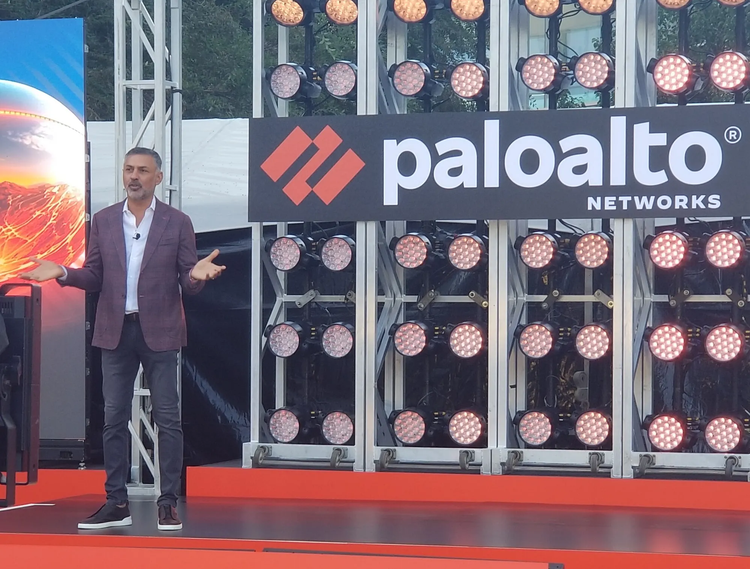
Palo Alto Networks is aiming to lay a massively stronger foundation for enabling AI and agentic adoption with the pair of multi-billion-dollar acquisition deals announced this year, Palo Alto Networks CEO Nikesh Arora said Wednesday.
The company’s $3.35 billion deal to acquire observability platform Chronosphere, disclosed Wednesday, comes on the heels of Palo Alto Networks’ planned $25 billion acquisition of identity security powerhouse CyberArk, announced in July.
[Related: Palo Alto Networks Unveils AgentiX Automation Platform: 5 Things To Know]
What the two M&A deals have in common, Arora said, is that both will allow the cybersecurity giant to enter new segments that are poised to be increasingly critical to enabling AI growth.
“I'm sure all of you are wondering why Palo Alto Networks, who is in the midst of a large acquisition of CyberArk, would engage in an acquisition at the same time of Chronosphere,” he said, addressing Wall Street analysts during the vendor’s quarterly call Wednesday.
“I think it's important to understand where we are in the AI cycle,” Arora said. “The AI cycle is moving fast. There's never a day that goes by without significant announcements on investments in AI data centers, AI infrastructure.”
The deal to acquire CyberArk—which is expected to close during the third quarter of Palo Alto Networks’ fiscal 2026, ending April 30—is in part aimed at addressing major needs around securing identities and privileges for agentic applications, he noted.
Likewise, the widespread adoption of AI systems is creating dramatically greater observability requirements, due to the differing behavior of AI workloads, according to Arora. And notably, those requirements are not being met by existing observability technologies that were built for a prior era of technology, he said.
Chronosphere, on the other hand, is a provider of “next-generation observability” with a platform that is both comprehensive and “always-on,” Arora said.
Meanwhile, even though observability has generally remained distinct from cybersecurity in the past, Palo Alto Networks sees the technology as an essential data platform for the enterprise that customers are asking for, he said.
“I just think [observability] is foundational to our ambition to be a very large tech company,” Arora said.
The planned acquisition of Chronosphere is expected to close during the second half of Palo Alto Networks' fiscal 2026, which ends July 31.
Following the completion of the deal, Chronosphere will be combined with the vendor’s Cortex AgentiX platform, Palo Alto Networks said. The vendor unveiled AgentiX, its new platform for building and governing AI agents, just weeks ago in late October.
“There's always been this sort of fantasy that observability and security will come together at some level,” Arora said during the call Wednesday. “It never progressed past that. Most of the observability vendors were so caught up in trying to solve the observability problem that they [only] dipped their toes in security.”
Arora also contended that the plan to acquire Chronosphere is not a departure from Palo Alto Networks’ usual acquisition strategy of recent years, despite the multi-billion-dollar price tag, in the same way as the CyberArk deal.
“This [acquisition price] is barely 2.5 percent of our market cap, which is consistent with our tuck-in strategy over the last seven years of acquiring companies,” he said.
For the first quarter of Palo Alto Networks’ fiscal 2026, which ended Oct. 31, revenue climbed 16 percent from a year earlier to $2.5 billion, surpassing the Wall Street analyst consensus estimate by $10 million.