Schneider Electric’s Gordon Lord On Making Partners More ‘Relevant’ With Software-Led Power Infrastructure Assessments
‘Now when we go in and talk to partners, we are much more relevant,’ said Lord. ‘Partners who looked at us once as an attachment now look at us as a reason to call their customers. We are giving them a reason to call their customers.’
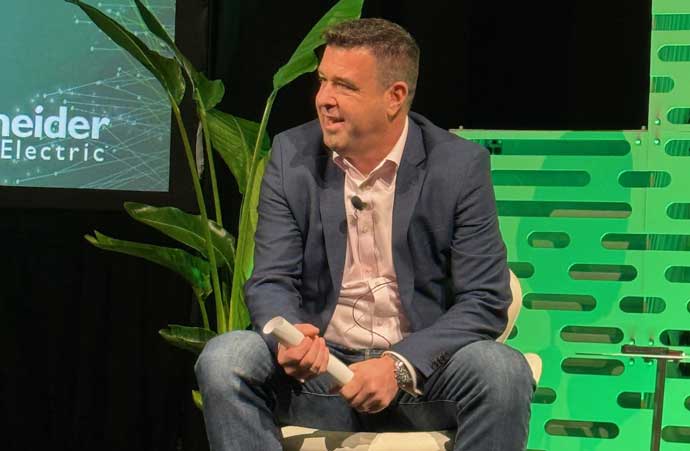
Schneider Electric Vice President of U.S. Channels Gordon Lord said the $38 billion power and cooling behemoth is making partners more “relevant” in the AI era with power infrastructure software-led assessments.
“Now when we go in and talk to partners, we are much more relevant,” said Lord (pictured) of the more than 1,200 power infrastructure assessments that have been done since the program kicked off in March. “Partners who looked at us once as an attachment now look at us as a reason to call their customers. We are giving them a reason to call their customers. That on its own is high value and puts us into more of those strategic conversations.”
Those strategic conversations are centered around upgrading infrastructure both in the data center and at the edge to power the new AI solutions that are forever changing the business landscape.
The power infrastructure assessments are identifying critical gaps in customer infrastructure, including UPS batteries that need to be replaced and how to manage infrastructure power more efficiently.
The next phase of the power infrastructure assessment sales offensive is doing “business planning” in 2026 to scale the software-led opportunity, said Lord in an interview at the company’s Innovation Summit North America in Las Vegas.
“Think about the thousands of UPSes installed in the market,” he said. “We don’t know where they all are. This is a great way for a partner to go call on their customer and for us to go mine our installed base together and to add real value to end customers. In the process, we are driving more revenue and margin for the partner and Schneider Electric.”
As to the big theme from the Innovation Summit North America, Lord said the key is for partners to continue to build out the software-led business.
“The primary conversation we are having right now is around software and the enablement behind it and the supporting programs that we have,” he said. “That is where we are shifting dollars and resources to get behind this in a bigger way. We did that to start off in 2025. We launched this really in March and we are going to continue to do this in 2026.”
Here is more of CRN’s conversation with Lord.
What is the big theme here at Innovation Summit as it relates to partners?
I think the big thing is continuing to be software-led. When you think about where Scheider is going as a company, you heard it this morning: We are an energy technology company. You are going to see more and more of that be software-defined. It’s all going to be driven by the data.
It is going to be a mix of assessment led with Schneider Electric consultant advisory services and then EcoStruxure [software]. Those to me are the two biggest things we are leading with.
What is the update on the power infrastructure assessment software channel offensive?
We just kicked off the power infrastructure assessment this year and the supporting gateway program. Last time I checked we had over 1,200 assessments and demos done with partners. I look at this as a foundational year.
We’ve just really launched this. We have had the software for a while. This was the year we made a real concerted effort on this. We got everybody in the channel organization behind this. We included in their compensation plans. We really started looking at how many assessments and how many demos we were doing with partners and customers. And we started to see the behavior change.
Now when we go in and talk to partners, we are much more relevant. Partners who looked at us once as an attachment now look at us as a reason to call their customers. We are giving them a reason to call their customers. That on its own is high value and puts us into more of those strategic conversations.
To the question about 2026 and what is the next revision of this, it is to sit down and have real business planning with each one of those partners to say how do we scale this. Think about the thousands of UPSes installed in the market. We don’t know where they all are. This is a great way for a partner to go call on their customer and for us to go mine our installed base together and to add real value to end customers. In the process, we are driving more revenue and margin for the partner and Schneider Electric.
Are we going to see Schneider Electric reward partners more for driving the software sale?
So maybe we would look at including it in deal registration. That is some of the feedback we are getting from partners.
We went out with this, and we learned along the way. At first, we were very focused on assessments. Now the assessments and demos are driving the behavior change for us and the partners.
The partners we have engaged with look at us a little bit differently. There is also the accountability around this too.
In the past we have done things like if you participated in multiple [Schneider Electric] categories maybe you would get a deeper solutions discount.
Maybe next year we look at something where if it is assessment or software-led then there are more incentives in there [for partners]. I think the message is we are just getting started on software.
Most people know us as APC. [Schneider Electric President of North America Operations] Aamir [Paul] talked about it this morning. We are becoming a platform company, and that platform is EcoStruxure. With the partners we are leading with EcoStruxure for IT, but then as partners get more comfortable with that it becomes the evolution of our partnership together to the wider Schneider, but it is all based on that platform, which is EcoStruxure.
What is the partner dynamic here at Innovation Summit North America?
I had some partners last night that came to me and said, ‘Wow, you guys are at the forefront of the business now.’ This is not an attach conversation. This is part of the overall conversation whether you are talking about AI or cloud. There is still so much unknown. We are all learning together.
The other thing that was exciting to me last night talking to partners is I don’t think they realized the scope and scale of the larger Schneider Electric. So many partners know us because of the APC brand. That is the core of what we do together. But to me it is the foundation of how we grow into the larger Schneider together.
We had over 60 U.S. partners here this week. I think they are all looking at us a little bit differently now.
The APC brand is the foundation. But Schneider and the energy technology company that we are represents a much bigger opportunity for us together whether it is in AI or it is in buildings. Our partners are playing in all these spaces.
How are the massive resources that Schneider Electric brings to the table changing the partner dynamic?
It has made it a lot of fun. We have gone from attaching to something to being part of the core [AI] discussion. We always talk about solution providers and providing value and our ecosystem of vendors and distributors. Our distributors are the aggregators that can bring all the different vendors and solution providers together.
So when you look at your networking vendor of choice, your server vendor of choice and your software vendor of choice and bring us in as part of that, [it] has to be orchestrated up front. You can’t just buy the new CPUs and GPUs and then figure out the power aspect of this. Too many people are finding that out the hard way now. We are a lot more strategic, which makes it a lot more fun.
How much investment is going into the channel from the Schneider Electric side to get partners trained and enabled to get data centers and enterprises ready for AI?
That’s the No. 1 conversation we are having right now. The primary conversation we are having right now is around software and the enablement behind it and the supporting programs that we have. That is where we are shifting dollars and resources to get behind this in a bigger way. We did that to start off in 2025. We launched this really in March and we are going to continue to do this in 2026.
How big is the AI, energy and services opportunity for the channel?
There are opportunities today.
There are opportunities with some of our partners deploying GPUs into the hyperscalers to potentially build out high-density pods in the white space.
But what really excites me is what is coming back on-prem. When I think about the data center buildouts of the early 2000s and how cloud shifted that, now you have an opportunity to modernize what’s left on-prem.
If you do it in a services-led way, specifically software assessments, it is unlimited [opportunity]. That starts a conversation about modernizing infrastructure to support compute at the edge. It also becomes the whole management and life cycle of that.
What advice do you have for partners to become more software-driven in their relationship with Schneider Electric?
It is a behavior change. Some partners are used to doing things the same way and they look at us the same way. I would say give it a chance. Try it with a customer. We have had inside sellers [from Schneider Electric] work with partners to do the assessment. We had one case where an inside sales rep deployed the assessment remotely for a Texas customer that had 400 UPSes, with the large majority of them with batteries that needed to be replaced. They had one battery that goes back to 2004.
The idea is we show the partner how it is done and then they can go do this on their own.
Aamir talked about the next 1,000-day journey with Schneider Electric. What does that mean for partners?
It is all about what AI is going to do to drive demand around power and how it is going to change the grid.
We need to expand capacity, but where we are really focused right now is on the energy efficiency part of this. The way you become more efficient, it starts with software.
How do you see the next 1,000 days as you work with Schneider Electric to drive the software-defined energy opportunity forward?
I feel like we have started it by leading with software. We set a pretty strong strategy. There was a lot of thought and time that went into building the strategy around software, and I think it is aligned with where all this is going.
Aamir talked about it this morning. We have been seeing what has been happening with the cloud service providers. AI is only going to accelerate that. This isn’t new if you look at the cloud service providers. This has been going on for a few years now. It has been a big driver of our business. That is where [Director of IT Channel Program Strategy] Jon [LoBello], myself and the rest of the team looked at what are we going to do differently with partners around this topic. For us right now it is software, and we have to do it in a bigger way.