The 10 Hottest Big Data Tools Of 2025
Here’s a look at the 10 hottest big data tools of 2025 including Amazon Aurora DSQL, Databricks Lakebase, the Qlik Open Lakehouse and Snowflake Intelligence.

Big Data, Hot Technologies
Data management tasks, including data integration, transformation and governance, have always been significantly important for operational and business intelligence purposes. But the need for these capabilities has taken on a new level of priority for businesses and organizations as the wave of AI technology development and adoption pushes demands for data to new heights.
The global “datasphere” – the total amount of data created, captured, replicated and consumed – is growing at more than 20 percent a year and is forecast to reach approximately 291 zettabytes in 2027, according to market researcher IDC.
But wrangling all that data, including collecting and managing it and preparing it for analytical and AI tasks, is a challenge. That’s driving demand for new big data tools and technologies – from both established IT vendors and startups – to help businesses access, collect, manage, move, transform, analyze, understand, measure, govern, maintain and secure all that data.
What follows is a look at 10 cool big data tools, designed to help customers more effectively carry out all these big data chores, that caught our attention in 2025.
They include next-generation databases, data lake systems, data management tools and data analytics software. Some are entirely new products recently introduced by startups or established vendors, while others are products that have undergone significant upgrades or offer ground-breaking new capabilities.
Amazon Aurora DSQL
Amazon Web Services touted Aurora DSQL as the world’s fastest serverless distributed SQL database with “virtually unlimited scale, the highest availability, and zero infrastructure management for always-available applications,” according to a blog post in May announcing the product’s general availability. (Aurora DSQL was previewed at AWS re:Invent 2024 in December.)
Aurora DSQL is designed to simplify the complex challenges often associated with relational databases. Customers can remove the operational burdens of patching, upgrading, and maintenance downtime to create a new database in just a few steps.
Applications running on Aurora DSQL can leverage the database’s fast distributed SQL reads and writes to meet any workload demand without database sharding or instance upgrades, according to Amazon.
The database is disaggregated into multiple independent components such as a query processor, adjudicator, journal, and crossbar. These components have high cohesion, communicate through well-specified APIs, and scale independently based on workloads. This architecture enables multi-region strong consistency with low latency and globally synchronized time.
CData Connect AI
Data connectivity technology developer CData Software debuted new software in September that integrates AI applications, agents, large language models, and workflows with 300-plus data sources, providing AI systems with the governed, real-time business data they need to operate effectively.
The Connect AI offering, which builds on the company’s flagship CData Connectivity Platform, links any AI application or framework that supports the Model Context Protocol (MCP) to more than 300 enterprise data sources such as databases and operational applications.
CData, based in Chapel Hill, N.C., markets its unified connectivity platform for integrating structured data in real time across enterprise applications and infrastructure for business analytics and AI tasks and for operational applications such as Workday and Salesforce. A number of leading software vendors incorporate CData’s technology within their products including Salesforce and its Data Cloud and SAP with its Business Data Cloud.
The new CData Connect AI is a managed MCP platform that provides data connectivity for AI agents and assistants, AI applications and AI workflows. The platform accesses data in-place in the source system—rather than moving or replicating it—and blends data across multiple sources to create reusable virtual datasets.
By inheriting existing security and authentication protocols set in the source system, Connect AI provides secure, governed data access that the company says solves permission and authentication workarounds inherent in MCP. And by utilizing a data-in-place approach, the software preserves data semantics and relationships, giving AI systems complete understanding of the data context.
AI systems need to comprehend what data means, not just where it resides, Chief Product Officer Manish Patel said in an interview with CRN. “With Connect AI, companies can for the first time give AI applications governed, live access to data across hundreds of systems with the contextual intelligence that transforms AI from a productivity experiment into a trusted enterprise tool.”
Patel said CData Connect AI goes beyond just providing one-way access to data sources. The system, for example, also allows an AI agent to act on the data, such as by creating a task for an operational application.
The Cloudera Platform
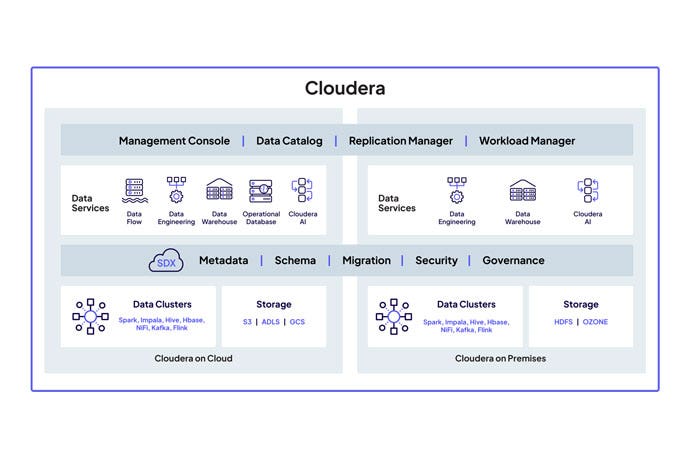
Cloudera, a long-time leading player in the data management and business analytics space, has been positioning itself as “the hybrid data company” with a platform the company says is better architected that the competition to provision AI workloads with data that’s spread across multiple public and private cloud systems.
Throughout 2025 Cloudera expanded its flagship platform with new capabilities, using technology both acquired and developed internally, and integrated its software with other vendors’ systems – the latter included integrating its platform with Dell Technologies’ Dell ObjectScale object storage to create the Cloudera Private AI platform.
In May, the company extended the AI capabilities of Cloudera Data Visualization, a tool used by data engineers, data scientists and business analysts, to on-premises environments. In September the company enhanced the Cloudera platform’s lakehouse functionality with key updates to Cloudera Iceberg REST Catalog and Cloudera Lakehouse Optimizer. And just last month Cloudera updated the platform with new unified data access, governance, and lineage features.
Cloudera is also making good use of its August acquisition of Taikun, a developer of technology for managing native Kubernetes and cloud infrastructure across hybrid and multi-cloud environments. With the Taikun technology, Cloudera can accelerate the deployment and delivery of the complete Cloudera platform, including data services and AI, across public clouds and on-premises data centers.

Confluent Intelligence
Confluent’s cloud-native data streaming platform is used to manage “data in motion,” connecting real-time data from multiple sources to stream across an organization for such tasks as real-time data analytics, AI applications and AI agents.
In October, the company debuted Confluent Intelligence, a new “fully managed stack” of technology built on Confluent Cloud that the company said provides a path for building and powering real-time, context-rich AI systems. Confluent Intelligence continuously streams and processes historic and real-time data, delivering data with context to scalable AI applications and workloads.
At the same time Confluent launched Real-Time Context Engine, a fully managed service that uses Model Context Protocol (MCP) to deliver real-time structured data and accurate, relevant context to any AI agent, copilot or large language model.
Confluent also unveiled Confluent Private Cloud, a simple way to deploy, manage and govern streaming data on private infrastructure.
Databricks Lakebase
At its Data + AI Summit earlier in June Databricks launched Databricks Lakebase, a fully managed Postgres data base for building data-intensive applications and AI agents.
Lakebase adds an operational database layer to the Databricks Data Intelligence Platform that the company said meets the need for fast, reliable data by today’s data applications, AI agents, recommendation engines and automated workflows.
In launching Lakebase, CEO and co-founder Ali Ghodsi says Databricks is taking aim at “traditional transaction” databases such as the Oracle Database and Microsoft SQL Server. In his keynote Ghodsi said Lakebase and other Databricks products unveiled at Data + AI Summit provide a way to “bring data and AI to as many people on the planet as possible. The reality on the ground is that it’s still really hard to succeed with data and AI.”
Lakebase is based on the open-source Postgres database technology Databricks acquired through its recent $1-billion acquisition of database startup Neon. It incorporates a data lakehouse architecture that Databricks says is more flexible than legacy databases and separates compute and storage for independent scaling.
Lakebase’s cloud-native architecture reduces latency and supports high concurrency and high availability needs, according to the company. It automatically syncs data to and from lakehouse tables and is integrated with Databricks Apps development capabilities and Databricks Unity Catalog.
At the Data + AI Summit Databricks also launched Agent Bricks, a unified space for building high-quality AI agents, and Databricks One, an edition of its platform that offers nontechnical business users with easier access to a number of Databricks data and AI capabilities.
dbt Labs Fusion
The popular dbt Labs data development and transformation platform got a major upgrade in May with the addition of the dbt Fusion engine that the company said dramatically boosts the system’s performance and scalability – and enhances the data developer experience – for building data pipelines and processing data at scale for AI and analytical applications.
With the new dbt Fusion engine, the company says its platform offers improved developer productivity, higher data velocity and cost savings through more efficient orchestration of data pipelines.
“AI is completely changing the way we interact with data. This is, seriously, the biggest launch in the history of the company and I am super, super excited to see the community response,” dbt Labs founder and CEO Tristan Handy said in an interview with CRN.
Fusion is written in the Rust programming language, which is seen as superior for building fast and reliable command line interface (CLI) tools – due, in part, to its ability to run multiple computations in parallel.
The Fusion engine powers the entire dbt platform, including the CLI, dbt Orchestrator, Catalog, Studio and other dbt Labs commercial products, speeding up parse times by a factor of 30x over the original dbt Core, according to the company. That enables faster analytics delivery, lower cloud costs and more trustworthy data pipelines for AI at scale.
Fusion is equipped with native SQL comprehension and other new capabilities that dbt Labs said collectively provide a “best-in-class developer experience.” Those capabilities stem from dbt Labs’ acquisition of SDF Labs, a startup developer of SQL code analyzer tools, in January.
Dbt Labs is currently in the process of merging with Fivetran.
Qlik Open Lakehouse
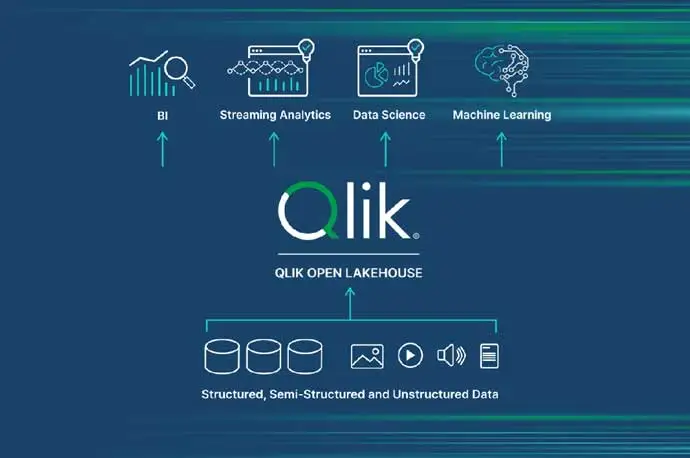
In May data integration, management and analytics software developer Qlik unveiled Qlik Open Lakehouse, a fully managed data lakehouse system built into the Qlik Talend Cloud that delivers real-time data ingestion at enterprise scale—millions of records per second—from hundreds of sources.
Qlik says Open Lakehouse provides 2.5x-to-5x faster query performance and up to 50 percent lower data storage infrastructure costs.
Qlik debuted the new product at its Qlik Connect conference, along with new advanced agentic AI capabilities for the Qlik Cloud platform and new embedded AI functionality in its Qlik Cloud Analytics service.
The new software and services are intended to help bridge what Qlik CEO Mike Capone called “the AI activation gap” by helping businesses and organizations more effectively collect and prepare data for AI and data analytics workloads and build workflows that act on AI results and analytical insights.
Qlik Open Lakehouse is based on Apache Iceberg – an open-source, high-performance data table format designed for large-scale datasets within data lakes. That provides the new data lakehouse with fully automated optimization capabilities including data compaction, clustering and pruning. The lakehouse also supports a number of Iceberg-compatible data processing engines including Snowflake, Amazon Athena, Amazon SageMaker, Apache Spark and Trino.
Snowflake Intelligence
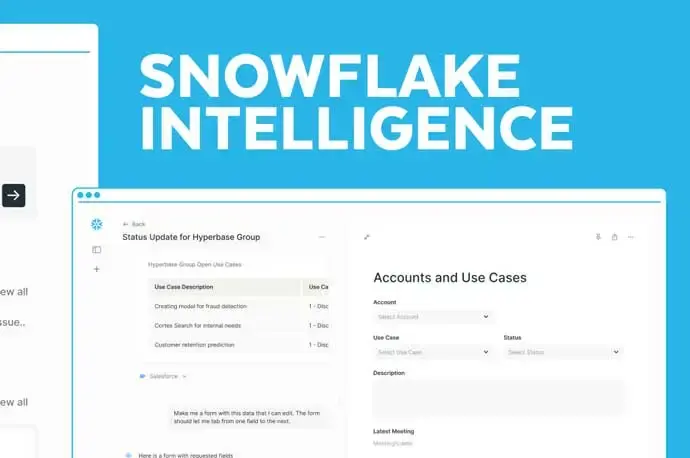
At its Snowflake Summit 2025 conference in June AI data cloud company Snowflake debuted Snowflake Intelligence, a conversational data analytics tool powered by intelligent data agents that allows users to ask natural language questions and uncover actionable insights from both structured tables and unstructured documents.
Snowflake Intelligence runs inside existing Snowflake environments, inheriting all security controls, data masking and governance policies, according to the company. It is designed to unify data from Snowflake, Box, Google Drive, Workday, Zendesk and other sources.
Snowflake also previewed Data Science Agent, an agentic companion that the company says boosts data scientists’ productivity by automating routine machine learning model development tasks.
Starburst Data Lakehouse AI Capabilities
The need to provide AI systems, including the current wave of agentic AI systems, with the huge volumes of data they need to function is proving to be a major hurdle for AI adoption and deployment.
In October Starburst expanded the functionality of its data lakehouse platform for the AI era, launching new capabilities that the company said help AI agents work with unified enterprise data, governed data products and metadata to better operationalize the agentic workforce.
Built on the core Starburst Data Platform, the new Starburst AI functionality provides a simpler data infrastructure for agentic AI workflows through which agents and people collaborate and so improve agentic productivity, according to the company.
The new offerings build on the company’s mission of “making that very complicated spaghetti of data infrastructure in your business vastly simpler, abstract the complexity, and provide data products that have governance and compliance baked-in [along with] tooling that helps you make that happen faster and accelerate data to the right places,” said Nathan Vega, Starburst senior director of product marketing, in an interview with CRN.
Starburst AI is based on the company’s flagship lakehouse platform, with the Trino distributed SQL query engine at its core, that Boston-based Starburst has offered for data analytics tasks since the company’s 2017 launch.
The latest developments boost the data governance and compliance functionality of the Starburst system with new, built-in model-to-data architectures, multi-agent interoperability, and an open vector store based on the Apache Iceberg data formatting standard. The new system empowers AI agents with unified enterprise data, governed data products and metadata.

ThoughtSpot Analyst Studio
Data analytics technology developer ThoughtSpot expanded the data preparation capabilities of its cloud-based analytics platform with the launch of ThoughtSpot Analyst Studio.
Analyst Studio, which debuted in January, makes it easier for data teams, including business analysts and data scientists, to collect, cache and transform data for AI and data analysis tasks, according to the company. The toolset accelerates and streamlines AI and data analysis processes, making it possible to generate analytical insights more quickly, and helps businesses and organizations manage the costs traditionally associated with multi-step, multi-tool data preparation and analytic systems.
“We believe that there is no BI [business intelligence] without AI, and there is no AI without data. And Analyst Studio is about creating AI-ready data,” said Sumeet Arora, former ThoughtSpot chief development officer, in an interview with CRN.
Analyst Studio uses its Datasets data extraction software, data visualization and profiling tools, and built-in connectors to help analysts collect, join and mash up data from multiple sources, such as databases and cloud data warehouses, and different file types such as Google Sheets.
Analysts can perform data transformation and preparation tasks using the integrated SQL IDE (integrated development environment) with AI Assist for writing SQL queries using natural language commands to assemble datasets for analytical and AI tasks, according to the company.
Data scientists and analysts can explore data and perform advanced analytics using a cloud-native SQL editor or using Python or R notebooks. Analyst Studio is integrated with leading cloud data platforms including Snowflake, Google BigQuery and Databricks platforms.
ThoughtSpot said that by providing a fully integrated suite of data management and analytical tools, Analyst Studio ensures data consistency and eliminates the inefficiencies of using separate, disconnected tools. Data teams can develop and execute complex data workflows that plug into their data ecosystems such as Snowflake’s Snowpark.
Analyst Studio is offered as an option for ThoughtSpot Cloud customers using either ThoughtSpot Analytics or ThoughtSpot Embedded. It’s debuted closely followed the November 2024 launch of ThoughtSpot Spotter, an agentic AI analyst tool that brings the analytical and reasoning skills of a data analyst to business users.