IBM CEO On How AI Will ‘Surpass The Boldest Expectations’ Over The Next Decade And Why Partners Need To ‘Start Early’
“We’re still in the early innings of enterprise AI adoption — the players are on the field, but the game is just beginning. If you’re not playing now, you’ll miss it entirely,” says IBM CEO Arvind Krishna in written responses as part of CRN’s CEO Outlook 2026 project.
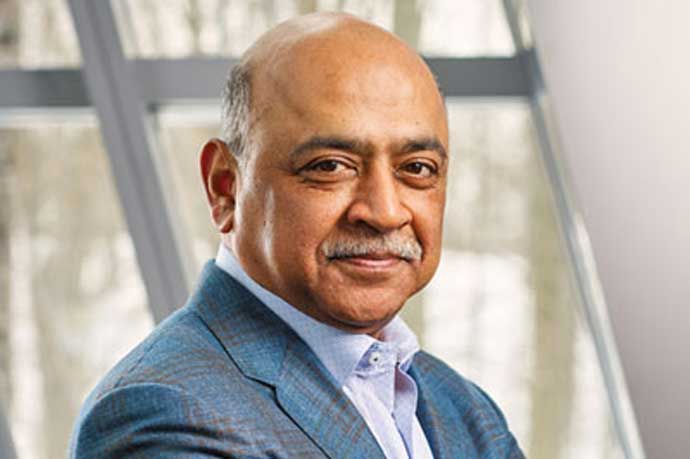
Arvind Krishna, IBM’s chairman and CEO, believes that 2026 will be a year of accelerated innovation across AI, hybrid cloud, specialized hardware, and quantum computing, with AI embedded into nearly every layer of IBM’s portfolio.
The CEO of nearly six years, in written responses as part of CRN’s 2026 CEO Outlook project, shared how his company is heads-down focused on delivering fast, measurable ROI by applying AI to practical and scalable use cases that will help enterprises modernize with confidence. Looking ahead to the rest of this year, Krishna said the biggest challenge for customers is impatience when it comes to AI. Enterprise AI is still in the early innings, but partners have a massive opportunity to reach customers using a simplified, AI‑first portfolio. “Over the next decade, AI will surpass today’s boldest expectations, driving a tenfold productivity revolution and long-term transformation. But the advantage will go to those who start early,” he said.
Krishna’s top priority for 2026? To succeed with partners. “We’ve grown partner-touched revenue by 50 percent in five years and my goal is that half of IBM’s total revenue will be partner-touched,” the CEO said.
Check out what else Krishna shared on his vision for AI and his goals for IBM in 2026 and see what more CEOs had to say about the upcoming year here on CRN’s 2026 CEO Outlook project.
IBM’s 2025 Fiscal Year
IBM has been on a mission to become a software and AI platform company. It’s paying off in the form of strong financials, including growth in infrastructure, software and hybrid cloud, the company shared at the end of January during its Q4 2025 and full-year earnings conference call led by Krishna.
For IBM’s fourth fiscal quarter 2025, which ended December 31, the company reported total revenue of $19.67 billion, up 12.8 percent from the $17.55 billion the company reported last year. This figure included software revenue of $9.03 billion, up 14.0 percent; consulting revenue of $5.35 billion, up 3.4 percent; infrastructure revenue of $5.13 billion, up 20.6 percent; and financing revenue of $179 million, up 5.3 percent. For the full fiscal 2025 year, IBM reported revenue of $67.54 billion, up from last year’s $62.75 billion.
What is the biggest market opportunity you and your channel partners will tackle together in 2026?
Clients know that staying competitive means advancing in AI, hybrid cloud, and automation, and those budgets remain strong. The drivers are clear: productivity, cost efficiency, and innovation. Technology is now the primary source of competitive advantage, helping companies offset costs and protect margins. IBM's AI book of business now exceeds $12.5 billion, fueled by demand for app modernization, workflow automation, and data insights, among others. But if you look at the top 100,000 businesses, IBM only works directly with 600. Keep in mind, there are roughly six million named enterprises out there. So that means partners are essential — and together, we're adding 10,000 new clients every year. The market clearly wants what we offer. Our opportunity is massive.
What are the key technology investments you plan to make in 2026?
In 2026, we’re accelerating innovation across our technology portfolio, including AI, hybrid cloud, specialized hardware, and quantum computing, the pillars of enterprise technology. We’re embedding AI into everything we deliver, from Cloud Paks and ERP modernization to IT automation and zSystems, where built-in AI enables real-time fraud detection. Our key investment priorities include: - watsonx Orchestrate and agentic workflows to transform business processes - AI assistants for mainframe and Power systems - Automation tools via Ansible, HashiCorp, and Apptio We’ll deepen adoption of Red Hat OpenShift and advanced virtualization to modernize workloads and drive hybrid cloud innovation. Building on the success of IBM z17, the first AI-era mainframe, we’re enabling hundreds of AI use cases with seamless hybrid integration, offering unmatched security and performance for mission-critical workloads. We’re also delivering high-speed, entry-level flash storage systems to help make enterprise-class storage accessible to businesses of all sizes and needs.
What impact do you expect AI to have on the business you and your partners do together in 2026?
The key to success in the AI era is delivering fast ROI and measurable productivity gains for clients. But integrating AI into enterprise workflows isn’t simple; it requires deep understanding of how work gets done and seamless connection to existing systems of record. That’s where IBM and our partners excel: embedding intelligence into processes like procurement, HR, and operations, with the right guardrails for trust and compliance. We’re already seeing signs of progress. A telecom client using AI in customer service achieved a 25-point Net Promoter Score (NPS) increase. In software development, AI tools are boosting developer productivity by 45 percent. And across finance and HR, AI is making processes more efficient, error-free, and fraud-resistant. These low-risk, high-impact use cases show how AI can transform enterprise operations when applied with deep domain expertise.
What do you see as the toughest challenges facing customers in 2026?
Patience is key. We’re still in the early innings of enterprise AI adoption — the players are on the field, but the game is just beginning. If you’re not playing now, you’ll miss it entirely. The real risk isn’t underestimating AI; it’s failing to deploy it effectively. That means starting with low-risk, scalable use cases that deliver measurable results. We’re already seeing AI investments translate into real enterprise value, and that will accelerate in 2026. Over the next decade, AI will surpass today’s boldest expectations, driving a tenfold productivity revolution and long-term transformation. But the advantage will go to those who start early.
What is the key to success for your channel partners in 2026?
Success for channel partners in 2026 will come from expanding beyond IBM’s traditional base and tapping into the 80,000 clients representing nearly half of the enterprise tech market outside the top 1,000 companies. Why does this matter? The top 600 clients consume nearly the full IBM portfolio. The next 1,500 focus on areas like storage, security, and software. But the next 80,000 prioritize fewer products: AI, Red Hat, and automation tools like Apptio and HashiCorp, where pricing is simpler and partners can move fastest. Our strategy is AI-first, centered and a focused set of priority offerings. Through our Partner Plus program, partners have access to training, marketing resources, and competitive financial incentives. We’re also giving partners multiple routes to market, from hyperscaler marketplaces and IBM Agent Connect to regional and emerging service providers, and accelerating resellers’ shift to SaaS.
Fill in the blank: My top priority for 2026 is...
My top priority for 2026 is to succeed with partners like never before. We’ve grown partner-touched revenue by 50 percent in five years and my goal is that half of IBM’s total revenue will be partner-touched, creating a healthy balance with direct sales. To get there, we’re investing in products and programs like Partner Plus, making it easier to drive recurring and consumption-based revenue. That’s the future we’re building, and I’m confident we’ll make big strides this year.