Commvault Debuts ‘Resilience Operations,’ Touting It As Key To AI-Era Data Management
‘ResOps processes restore your business and keep your data reliable, governed and trustworthy. In essence, resilience now runs the business,’ says Commvault CEO Sanjay Mirchandani.
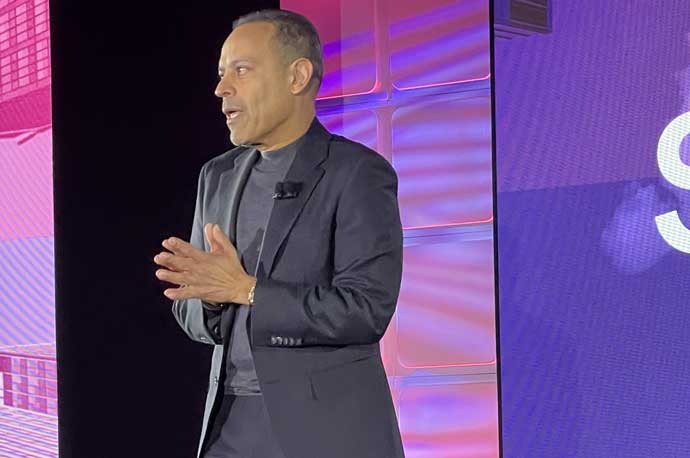
For data protection and resiliency technology developer Commvault, a focus on the reliability and resilience of business data is giving a whole new meaning to the term “ResOps.”
While in the wider technology area ResOps is an acronym for research operations, Commvault CEO Sanjay Mirchandani is now touting ResOps as short for resiliency operations.
Mirchandani, during his keynote address at this week’s Commvault Shift conference in New York, said that data resiliency is becoming the key to business success and even survival, particularly as the massive adoption of AI opens new avenues not only for cyberattacks but for AI itself to change a customer’s data without the customer knowing about it.
[Related: Commvault Takes Data Resiliency Head-On With New Commvault Cloud Unity Platform]
Commvault two years ago elevated data protection to a more strategic posture with cyber resilience as an operational state where IT and security could confront pervasive threats and emerge strongly, Mirchandani said.
“It’s rapidly become the standard of our industry,” he said. “And today we’re going to raise the bar again with AI resilience. This is the defining challenge in the age of AI. It’s not enough to just secure the infrastructure.”
With AI, businesses now have thousands of intelligent and autonomous agents making decisions and mistakes with little to no human oversight, which is why AI resilience requires them to broaden their operational focus, Mirchandani said. They also need to continuously secure data at the source and monitor for any anomalies while autonomously controlling the identities of the individuals and \devices that access and use that data while being able to recover data at massive scale without corruption, he said.
“To achieve AI resilience, you must bring security, identity and recovery together,” he said. “Your organization is counting on you to deliver resilience in the age of AI.”
Traditional approaches and processes around resilience are typically no longer enough as they can’t keep pace with the speed and scale of AI-driven systems, Mirchandani said.
“This is further complicated because the teams responsible for resilience, like SecOps [security operations], data security and recovery, often have their own tools, policies and requirements,” he said. “To combat this, many of the CIOs and CISOs that I speak with are exploring progressive approaches to unifying, to bring together, these critical resilience activities.”
Furthermore, Mirchandani said manual error-prone processes around data security and identity are quickly evolving with the advent of agentic AI.
“If you’re unable to keep pace with agentic AI, your business is potentially at even greater risk, which is why we’ve re-envisioned resilience for the age of AI,” he said. “We’ve been calling this new operational approach ‘ResOps,’ or resilience operations. It’s not a tool or a point solution. ResOps is the next operating model that transforms resilience into an active discipline and enables you to manage resilience across increasingly complex and emerging AI environments.”
Commvault sees ResOps as a continuous, automated loop that reinforces resilience across data security, identity and recovery, Mirchandani said. The first steps are all about understanding a company’s data, its sensitivity and who is accessing it.
“This includes real-time sort of access policy enforcement,” he said. “For example, LLM prompt protection to govern how AI data is accessed in real time. Next up is the continuous detection. This is where you automatically scan for and detect potential issues, anomalies, cyberthreats, to minimize the impact of compromised identity systems and damage data. Then, with automation at its core, a strong ResOps practice will enable you to confidently and intelligently recover your critical data, re-establish access to key systems and restore your business.”
This includes quickly recovering to a Commvault clean room or an isolated environment for testing and forensics, or even better, moving clean, trusted data back into production, Mirchandani said.
“ResOps processes restore your business and keep your data reliable, governed and trustworthy,” he said. “In essence, resilience now runs the business, which brings us to what we’re all about. … Commvault has always been obsessed with solving our customers’ most significant resilience challenges with elegant and innovative solutions. We’ve been working on this challenge for years and are again upping the ante to give you what you need to embrace ResOps to compete and win in an AI-driven world.”
Dave Hiechel, president and CEO of Eagle Technologies, a Salina, Kan.-based solution provider and longtime Commvault partner who was at the Commvault Shift conference, told CRN that data protection and resiliency have gone through massive changes in the last few years.
“It used to be when you started in IT you became a backup dude,” Hiechel told CRN. “Now you’re the first one to speak at a meeting to understand how your data is doing. And I think ResOps is really about that resiliency and how it fits into the operational side of the house. We’re no longer talking to the backup administrator anymore. We’re talking to somebody that is really key in the whole IT infrastructure. So I think the term is cool.”
Hiechel said he can pull out a slide he used 15 years ago that shows people on one side and ones and zeros on the other, with everything in the middle just the plumbing.
“It really is all about the data and getting that data to people in a usable format,” he said. “That doesn’t really mean disaster recovery. If you do DR, you can bring systems up, but if people don’t have access to the data, it’s not valid. So Commvault’s data resiliency messaging and how that fits operationally now is really key. The messaging is spot on as far as that’s concerned.”