HPE CEO Antonio Neri On ‘Huge Benefit’ Of Moving From VMware By Broadcom To HPE Morpheus VM Essentials
‘If you are a partner, the opportunity there for you is to land Morpheus and then sell your migration services,’ said Neri in an interview at HPE Discover 2026. ‘And then when you go to VM Essentials, including containers and runtime for virtualization, you reduce up to 90 percent of your cost because in addition to the fact that we charge less, the commercial [pricing] model goes from cores to per socket.’
HPE President and CEO Antonio Neri said there is a “huge benefit” for partners to get back in the virtualization game with HPE Morpheus VM Essentials to displace VMware by Broadcom.
“If you are a partner, the opportunity there for you is to land Morpheus and then sell your migration services,” said Neri in an interview at HPE Discover after HPE unveiled new incentives to help partners grab virtualization market share. “And then when you go to VM Essentials, including containers and runtime for virtualization, you reduce up to 90 percent of your cost because in addition to the fact that we charge less, the commercial [pricing] model goes from cores to per socket. So it’s a huge benefit. For the partners this is an opportunity to get back in the game, which has been obviously eliminated through the transition Broadcom made [when it acquired VMware]. So No. 1, this is making partners relevant. No. 2 is we allow partners to capture the migration services opportunity because they are the support partner of choice for the customer.”
Neri’s comments came after HPE unveiled a migration assistance program that allows new HPE VM Essentials customers to receive up to one year of complimentary licensing with the purchase of a three-year license to avoid double-paying for another hypervisor.
In addition, HPE is providing one year of HPE Zerto Advanced Resilience Edition for $1, enabling customers to migrate and protect up to 25 VMs at a time with near-online migration and disaster recovery capabilities, helping ensure a nondisruptive transition to HPE Virtual Machines.
After Broadcom acquired VMware three years ago for $61 billion, the company eliminated thousands of partners and dramatically increased prices on VMware licensing. Partners are still in the midst of helping customers that are being hit by licensing renewal price increases, in some cases of 2X to 4X.
CRN reached out to VMware but had not heard back at press time.
Neri said that beside the cost difference, HPE Morpheus VM Essentials provides partners with a platform that is “way more modern, way more automated, way more open.”
Neri pointed out that Morpheus is based on “true open” standards. “It’s not proprietary,” he said. “We took what was open source and we integrated a lot of tools into it. No. 2, we made it enterprise- grade, which means that we provide indemnification on that platform. No. 3 is we integrated the networking piece of it with Juniper. Now we have software-defined networking—no different than NSX was inside VCF [VMware Cloud Foundation].”
HPE has also moved quickly to build a lot of AI intelligence into Morpheus VM Essentials with the release of Morpheus 9.
Last but not least, Morpheus VM Essentials provides partners and customers with the flexibility of a unified hybrid operating model.
“That means when you use Morpheus you can manage all your public cloud instances and all your multi-runtime instances,” said Neri. “Morpheus manages VMware, Nutanix, OpenShift and our VM Essentials. Once you align to that and standardize on that cloud control plane, which is in the Green Lake platform, then you decide at what pace you’re going to transition from, let’s say, VMware to VM Essentials. That transition is very seamless because it’s under the same ecosystem.”
Neri also spoke about HPE’s surprise decision at HPE Discover that it has extended price quote validity from 14 days to 30 days for servers, storage and GreenLake Flex.
The 30-day price validity comes four months after HPE informed partners that the company was making the changes in “pricing and quote validity” to 14 days in the wake of rising memory prices and supply constraints plaguing the industry.
“We gave a commitment to ourselves that the first possible moment we could reverse back to 30 days we would do it,” said Neri. “While it is not all perfect, we said we feel good enough to do it now even though there is some risk associated with it.”
Here is more of CRN’s conversation with Neri.
What is the message you are sending to partners with the move to 30-day price quote validity?
We understood early on this was going to be very tough—tough for customers and tough for partners. [We realized] the fact that this is an incredible challenge for everyone.
Some of the partners couldn’t really quote in 14 days. They had that challenge. We gave a commitment to ourselves that the first possible moment we could reverse back to 30 days we would do it.
While it is not all perfect, we said we feel good enough to do it now even though there is some risk associated with it. We did it across the company because you don’t want to do it for one business versus the other business.
We listened to partners. I think it is another testament that we are partner-centric and customer-centric. We felt this was the right time to do it.
Does this signal we’re going to see more aggressive pricing from HPE to win servers, storage and GreenLake Flex?
I think we’re going to be as aggressive as we can be, understanding that the supply constraints continue to be there and will be there for a long period of time.
I think it’s important that we add the rest of the value around that infrastructure so that we can be as aggressive as possible on the hardware itself.
If you add more software and services then you can be a little bit more aggressive, but if you sell just hardware you’re going to compete on pure price versus everything we offer around the agentic enterprise with software; [HPE] Private Cloud AI; everything we do around storage, which obviously has a huge content of software around it; everything we do around networking, where the margins are structurally so different.
When we sell the entire portfolio that allows us to get even more aggressive on the server side of the business.
What are the biggest HPE differentiators for Morpheus VM Essentials in the agentic AI era versus VMware by Broadcom including VMware Cloud Foundation 9?
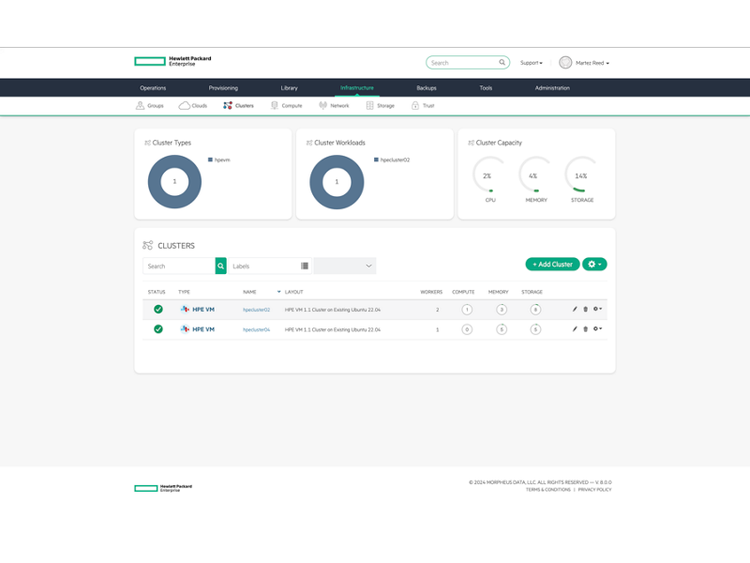
First of all, we give our customers and our partners flexibility and control. That starts by leveraging Morpheus. Morpheus Enterprise gives you a unified operating model that’s truly hybrid. That means when you use Morpheus you can manage all your public cloud instances and all your multi-runtime instances.
Morpheus manages VMware, Nutanix, OpenShift and our VM Essentials. Once you align to that and standardize on that cloud control plane, which is in the Green Lake platform, then you decide at what pace you’re going to transition from, let’s say, VMware to VM Essentials. That transition is very seamless because it’s under the same ecosystem.
So if you are a partner, the opportunity there for you is to land Morpheus and then sell your migration services. And then when you go to VM Essentials, including containers and runtime for virtualization, you reduce up to 90 percent of your cost because in addition to the fact that we charge less, the commercial [pricing] model goes from cores to per socket. So it’s a huge benefit.
For the partners this is an opportunity to get back in the game, which has been obviously eliminated through the transition Broadcom made [when it acquired VMware]. So No. 1, this is making partners relevant. No. 2 is we allow partners to capture the migration services opportunity because they are the support partner of choice for the customer. We give them all the technology tools underneath that.
When you buy a private cloud stack from us, whether it’s the PC3000 or our other private clouds, the same [virtualization] stack is already integrated into it.
Whether it is virtualization or private cloud it is the same stack, except for Private Cloud AI where we use GPUs and unstructured storage like Alletra X10000 and then the Nvidia software on top of it.
Is Morpheus VM Essentials a more modern platform versus Broadcom by VMware?
There are four parts to this that are important. No. 1 is Morpheus is based on true open standards. It’s not proprietary. We took what was open source and we integrated a lot of tools into it.
No. 2, we made it enterprise-grade, which means that we provide indemnification on that platform.
No. 3 is we integrated the networking piece of it with Juniper. Now we have software-defined networking—no different than NSX was inside VCF [VMware Cloud Foundation].
No. 4, which I think is very important, is the fact that we give you flexibility. You can run all these multi-runtimes concurrently, but then you can decide which way you want to go, at what point in time you want to move on. Then we built in a lot of intelligence, which is AI-driven. So Morpheus 9 now has a lot of AI embedded in it, and then we leverage the OpsRamp observability into the platform. So yes, it’s way more modern, way more automated, way more open.
What is the opportunity for partners to go after the Dell VxRail installed base with VM Essentials, and what is the difference versus Dell?
Customers who adopted VxRail adopted it because they loved the pre-integrated offer and software-defined storage like [VMware] vSAN.
vSAN is no longer part of the equation because Dell doesn’t own it. We offer all of that with our file object solution, but really there is the file opportunity that comes pre-integrated with our Private Cloud enterprise PC3000. So we provide an easy path for customers and partners. If you love that infrastructure, you just go to that. And remember, Morpheus Enterprise helps you deploy it from one place to the other.
What is the difference in terms of pricing and return on investment for networking in the agentic AI era for the HPE Juniper self-driving network, particularly in the data center versus Cisco with the new announcements HPE made here at Discover?
We are building what I call the best networking business on the planet. That’s our vision. That vision is sustained by the fact that we now have a complete portfolio across campus and branch, data center networking, security and, obviously, the routing business, which is the data center interconnect.
When it comes down to self-driving, we started originally in the [Juniper] Mist space. We cross-pollinated into the Aruba space, then into the data center space and into the routing space. That is a unified experience now from scale up to scale out to scale across all the way to the edge.
That unification is so important because if you are a network operator you may want to deal with an access point just as you want to deal with a port in the data center or a port into the routing space. That is a unique value proposition because it helps you reduce OpEx.
With the amount of [network] telemetry data we are now generating, humans cannot process it. The AI allows us to really manage that at scale. This autonomous concept is becoming a reality because as infrastructure grows and these large data centers are built, you are moving a lot of tokens through it. So the question is how we do that in a cost-effective and secure way? That’s what the self-driving concept is about.
HPE made a lot of security announcements here. What is the difference between how HPE approaches agentic era AI security versus Cisco with Splunk?
They got into the SIEM space, which is a whole different domain than security as a whole. We think about security in multiple ways. No. 1, in the networking layer there is the convergence of security and networking coming together.
Obviously, we know that at the edge through the SASE framework, the Secure Access Service Edge, the SSE, is something that we are delivering now with a modern architecture. We call it EdgeConnect. Obviously, you still have to have firewalls for many aspects of that.
When you go to the other side of the portfolio, you start with infrastructure all the way up to the app. We are driving security at every layer of the stack. Then we bring all that together in networking thought the zero-trust architecture. That’s why we have a unique value proposition that is not just about helping customers be more secure, but also bringing it all the way to the agentic models that we talked about today and yesterday. All of that gets built into the platform itself like Private Cloud AI. It’s really about reducing the overhead associated with security, which is cost for customers.
What are the implications for security that you see with Mythos?
I think it changes everything. It is not about a specific [LLM] model. All the models are going to become so proficient. It provides the ability to analyze vulnerabilities to a level that humans couldn’t do.
The reality is that these models are now reasoning to a level that they can connect with other models along the way, and they become experts in different areas, and when they come together, they say there is a vulnerability there.
That’s what we’ve seen here and the question is: How do you use it defensively to really proactively assess what are the challenges across your enterprise so you can go and address those challenges before something bad happens? That’s the great thing about AI and the bad thing about AI.
Does HPE have access to Mythos?
We got a number of tokens to use to understand how this is evolving. Also remember, the United States put out an executive order that put it on hold. We use it to understand are we having some vulnerability across our enterprise or even in our products? It is a journey. We are going to go on this journey together and figure out how this works.