10 Hot Products And Services For MSPs Right Now
Attendees at the XChange August 2025 conference got a first-hand look at a wide range of new hardware, software and services aimed at helping MSPs expand the offerings they can bring to their customers.

MSPs who attended last week’s XChange August 2025 conference in Denver had ringside seats into what is driving managed services, a fast-growing part of the IT industry.
At the conference, which was hosted by CRN parent The Channel Company, MSPs found a variety of ways to build their business.
[Related: 14 Hot Products And Services For MSPs Right Now]
They learned some of the keys to valuing their business in the event of a merger or acquisition, how the rise in AI use will impact their growth, how to embrace the autonomous service era, the advantage of making security a recurring revenue service and more.
They also got a chance to discuss what happens when an MSP realizes the advantage it and its employees receive when it looks beyond profit margins to embrace community service.
And then there were the products. A host of vendors used their sponsored sessions and the Solution Pavilion show floor to introduce a host of new hardware, software and services aimed at helping MSPs find new ways to grow their customer offerings.
CRN rounded up 10 of the hottest products and services aimed at the MSP community from XChange 2025. Here’s what is now available or soon to be available to MSPs.

Buffalo Americas Enhanced Security Suite
Storage, backup and portable media technology developer Buffalo Americas demonstrated a new cybersecurity focus in its storage devices at XChange. Ben DeLaurier, COO of the Austin, Texas-based company, described the new Buffalo Enhanced Security Suite as a very robust set of security measures for the company’s TeraStation NAS line.
The key new capability is real-time threat detection, where it’s capable of recognizing if unusual activity is happening in the storage offering, DeLaurier told CRN.
“Let’s say you’re writing a bunch of stuff to it the first time,” he said. “That’s going to be an abnormal amount of writing for the first time. But then as you’re putting more data in there and there’s data churn, there’s an expected amount of data. And if that churn, let’s say it’s five files today, five files the day after that, five files the day after that for three weeks, then all of a sudden 7,000 files are updated, that’s an unusual activity, likely ransomware, which reads and writes over every one of your files with an encrypted version. So it’s defense in-depth.”
The Buffalo Enhanced Security Suite in part works by comparing current data snapshots with older ones, DeLaurier said.
“It looks at the difference between snapshot A and snapshot B to determine if it noticed something unusual,” he said. “It will take and hold snapshot A until you say that it’s OK to let it go. In addition, we also have built in immutable backups of the snapshots. So even if an attacker has the administrator password, God forbid, they can’t delete that snapshot. And because the administrator can’t reformat the RAID with immutable snapshots, they can’t break the RAID or dismount drives. Really, the only way to get to that data and damage it is to physically attack the box.”
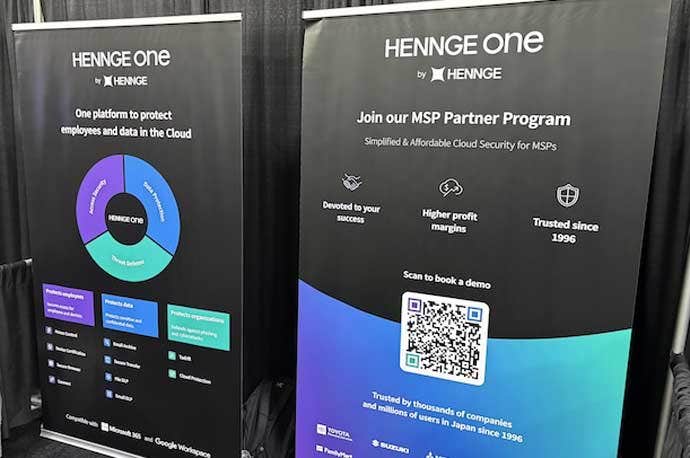
Hennge One
A new entrant to the North America market, Hennge Inc. is a joint venture between major Japanese cybersecurity vendor Hennge K.K. and venture capital firm SunBridge Corp., formed to bring the Hennge One platform to SMBs in the U.S., Canada and Mexico, according to Hennge Inc. CEO Robert Sharp. Hennge One offers three products—access security, data protection and threat defense—available for pricing of $10 per user, per month, the company told CRN. Hennge Inc. is focusing on delivering its platform through MSPs and bringing product capabilities that have previously been too complex for many SMBs to adopt, Sharp said. Meanwhile, “a lot of SMBs, particularly when they’re starting their cloud security adoption journey, don’t understand the full opportunity of bringing in sophisticated technologies,” he said. The simplicity of the offering should enable more SMBs to adopt these capabilities for the first time through their MSPs, according to Sharp.

Slide
Slide overhauls the backup and disaster recovery experience for MSPs. The Norwalk, Conn.-based startup delivers a cloud-first offering optimized for speed, security and simplicity, providing backup and recovery at 10-Gigabit network saturation, far surpassing typical legacy systems.
Slide is built to serve cloud and on-premises environments, with a flexible design and an open integration strategy that includes partnerships with other backup vendors. The company is positioning itself as a modern alternative to aging solutions that many MSPs still rely on, with a focus on innovation, partner collaboration and speed of execution.

Wasabi Air
One thing coming soon from Wasabi is an update to Wasabi Air AI-based intelligent media storage, said Drew Schlussel, senior director of solutions and industry marketing at the Boston-based cloud storage vendor.
“We are also working in partnership with IBM as well as a few other vendors on extending our technological reach beyond just the storage into things like an AI-driven recognition engine for video,” Schlussel said. “The key thread there is we’re going to be disrupting the economics of this part of cloud services.”
Wasabi Air was actually introduced last year, but the company was pretty quiet about it, Schlussel said.
“Now we’re going to get loud again, but we’re approaching the market very differently this time,” he said. “We’re not necessarily going to go after a direct-to-business model. We’re going ti work this entirely through channels, through system integrators, through solution sellers, who will leverage this technology as part of their offering to their media customers. We’re taking an ‘ingredient,’ or component element, approach this time around. This is a massive market. But it’s the channel partners that matter most. They understand the problems the best. They understand where and how the solution can be implemented best.”
Wasabi at XChange also talked about the company’s new relationship with Dell Technologies. Schlussel said Dell is not only reselling Wasabi Hot Cloud Storage but worked with Wasabi to stand up a version of Hot Cloud Storage based on Dell’s ObjectScale technology.
“For Dell customers that want to stay within the Dell ecosystem, Dell maintains absolute account control,” he said. “Customers can tier their data from their Dell kit on-premises to Dell kit off-premises.”
Wasabi is also continuing to strengthen its IBM partnership, Schlussel said. The company recently stood up a data center in London where IBM is more or less operating an instance of Wasabi, and there are wheels in motion for additional partnerships or additional work with IBM to replicate that model, he said.

Cynet
Cynet’s all-in-one cybersecurity platform brings together threat prevention, detection, investigation and response in one unified, easy-to-use offering. Designed specifically for small to midsize enterprises and MSPs, Boston-based Cynet delivers protection with minimal complexity and maximum value. Covering everything from endpoints to cloud environments, Cynet uses MITRE-tested detection to safeguard entire infrastructure. The company also automates threat response, filtering out false positives, analyzing incidents and remediating attacks
And with a simple interface and fast deployment, Cynet makes enterprise-grade cybersecurity accessible to organizations of all sizes.
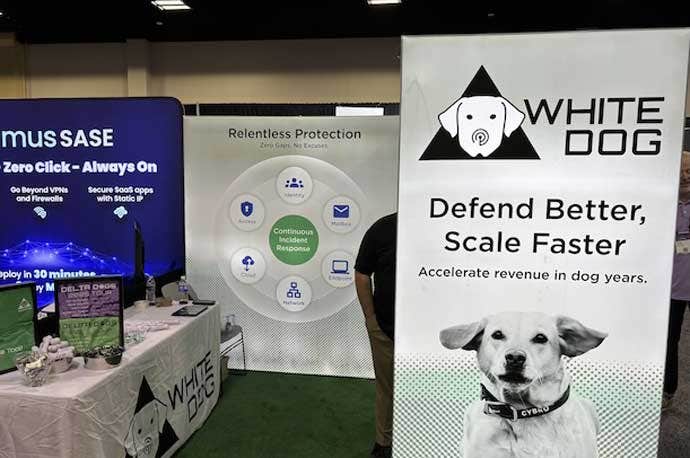
WhiteDog Cybersecurity 𝚫DR
Founded by channel veteran Shahin Pirooz, Santa Clara, Calif.-based WhiteDog Cybersecurity debuted its new 𝚫DR platform in June with the aim of offering an entirely new cybersecurity category for MSPs that addresses shortcomings in other detection and response technologies. Covering the five most important threat vectors—endpoint, network, email, identity and DNS—𝚫DR also provides capabilities including attack surface management and security posture management. This offers a superior approach to extended detection and response (XDR) for partners of WhiteDog, which drives 100 percent of sales through the channel, Pirooz told CRN. “What we do is we capture the gaps that XDR doesn’t,” he said. “We’re doing the deltas.”
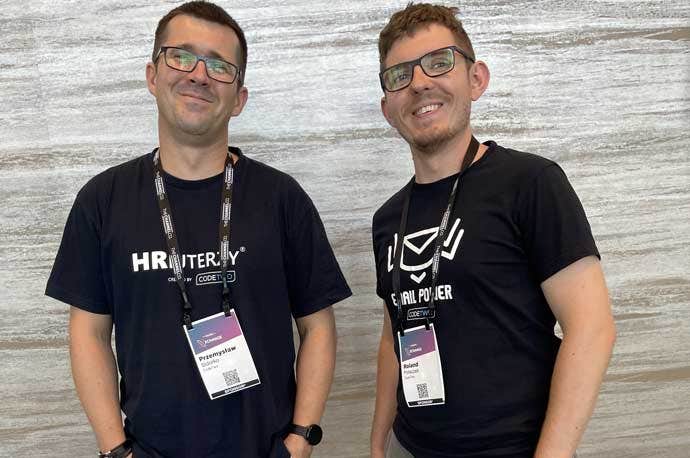
CodeTwo On-Premises Exchange Protection
Poland-based data protection software developer CodeTwo showed off the latest versions of its product line, including its flagship email signature management software, its data migration software and its data backup software.
Roland Potaczek (right in photo), CodeTwo’s senior customer success specialist, told CRN the company recently released a version of its email signature management software designed for use with Microsoft Exchange on-premises.
CodeTwo’s latest release was a new product for on-premises Microsoft Exchange in anticipation of a new Microsoft Exchange subscription, Potaczek said.
“There are fewer and fewer products for the actual on-prem Exchange,” he said. “We want to accommodate customers who are migrating to Exchange. It includes email signature management along with a couple of additional features like automatic replies and mail flow management, as well as the ability to block messages based on keywords such as sensitive data, say, if a credit card format is detected in the message.”
Because the on-premises version of Exchange is hosted locally, customers can do things they can’t with the cloud version, Potaczek said.
“You can do much deeper integrations,” he said. “With the cloud solution, we really cannot get too deep into your config. We can’t, for example, read your messages. With the on-prem version, as it’s hosted on the customer end, the tool can do much more. Customers can utilize such features as checking attachments and checking message content without going through any of our services.”
In a way, it’s not that new, said Przemyslaw “Paul” Sidorko, CodeTwo’s technical sales manager.
“We’ve continued to have on-prem solutions, and in this area, among our competitors, we are the only ones who actually have an on-prem tool,” he said. “We just updated it to meet the requirements of Exchange.”
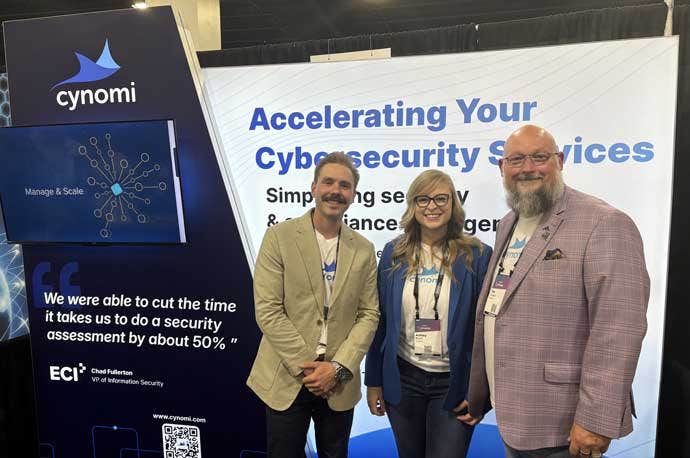
Cynomi
Israel-based Cynomi empowers MSPs and MSSPs to deliver virtual CISO (vCISO) services at scale without increasing head count. Its AI-powered, multitenant platform automates the core functions of a vCISO, enabling partners to serve more clients effectively. Cynomi automatically generates comprehensive risk and compliance assessments, customized security policies and detailed, prioritized remediation plans. The platform also includes built-in task management, progress tracking and customer-ready reporting.
Todyl GRC
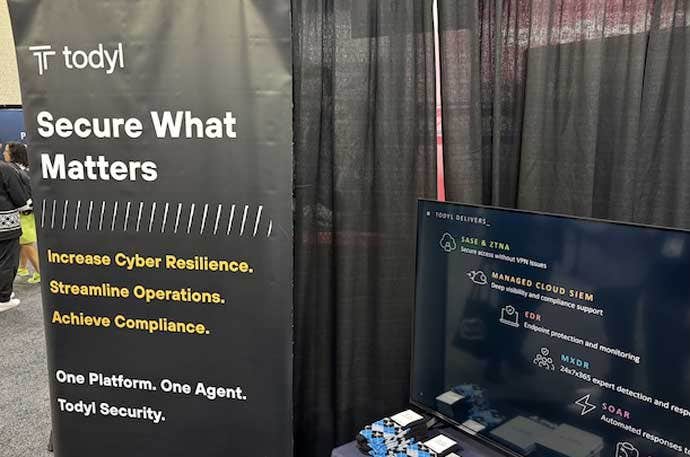
Todyl’s MSP-focused cybersecurity platform covers segments including SASE (secure access service edge), endpoint security, SIEM (security information and event management) and managed XDR (extended detection and response). The most recent addition to the Todyl platform is an offering for GRC (governance, risk and compliance), which is “kind of the final piece of the puzzle,” said Ken Patterson, director of community at Denver-based Todyl. The platform can now take data ingested through SIEM and “correlate it to GRC and be able to tie that to the different compliance frameworks,” Patterson told CRN. “We’re able to check those boxes automatically.”
Panduit Distribution Expansion
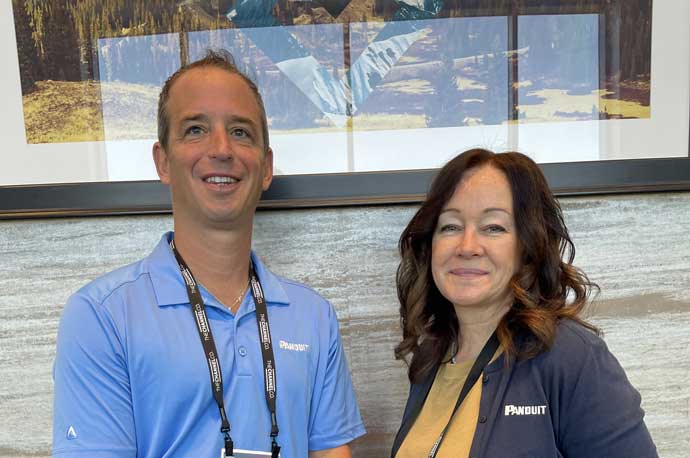
Panduit at XChange introduced an exclusive partner program for MSPs to quickly access the company’s technology via IT distribution, said Carrie McLeod Peterson, channel account manager of the developer of network, data center and industrial infrastructure products.
“We now already have products loaded and ready at IT distribution for those day-to-day smaller projects,” Peterson told CRN. “And as larger projects come up, let’s talk. We can have a three-way call, even with a technical sales engineer if the end customer might need some help with designing and creating their bill of material. We’ll make sure everything is lined up for success.”
Panduit took to XChange to make sure smaller MSPs and solution providers know the company and its products, said Sean Vanderhoof, the company’s senior business development manager.
“Most people don’t know us from the IT side,” Vanderhoof told CRN. “They know us from where Panduit has been all of our life, which is in the electrical world, the datacom channel. We’re here to help them understand that we’re invested in the space.”
Tinley Park, Ill.-based Panduit is an engineering company that builds technology based on the voices of customers, Vanderhoof said.
“And we ended up building products that this channel sells,” he said. “And we realized, ‘Wait a second, these guys sell a lot more of it. We need to be more engaged here. We need to be present.’ We’re really here to garner the appropriate feedback.”
Panduit is very aligned with a lot of larger hyperscalers and engineering alliances of companies including Cisco Systems, Dell Technologies and Nvidia, Vanderhoof said.
“We’re trying to mold those integrations into a message for this channel, to understand we support it with a deal registration program and incent partners to include us when they’re talking about those partners.”