How MSPs Can Better Measure Customer, Employee Happiness: Consultant
When it comes to customer satisfaction, MSPs should examine service delivery metrics that reveal what customers experience when something goes wrong, including how quickly a technician responds to a ticket, first-call resolution, ticket reopen rates and more, says Tonya Petrozzi, business coach and consultant for Petrozzi Coaching & Consulting.
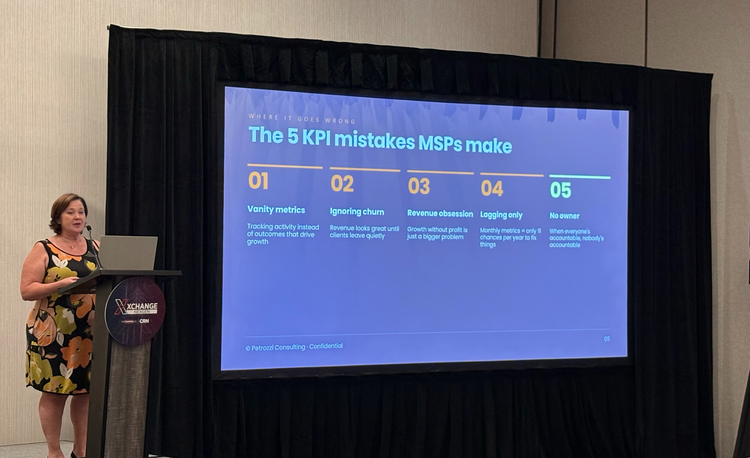
MSPs should look beyond customer satisfaction surveys and employee resignation letters to gauge the level of happiness being experienced by both groups.
That was the message from Tonya Petrozzi, business coach and consultant for Petrozzi Coaching & Consulting, who said MSPs typically struggle to measure happiness because it feels subjective compared with financial performance, ticket volume and other operational data.
Speaking at CRN parent company The Channel Company’s XChange NexGen conference in Orlando, Fla., this week, Petrozzi said by tracking leading indicators, MSPs can identify warning signs early and take action before an employee leaves.
[Related: MSP Panel: Clients Want To Use AI To Cut Staff, But It Doesn’t Work Like That]
“[Customer and employee happiness] are the hardest to measure because people feel like happiness is a feeling and it’s a state and it’s less tangible than some of these other things,” she said. “But we have to look at the leading indicators that help drive these.”
For customer happiness, she advised against relying too much on customer satisfaction scores and Net Promoter Scores. While surveys can provide feedback, she said response rates are typically low. “In my experience, we get a 10 [percent] to 12 percent response rate on our [customer satisfaction] scores,” she said.
Instead, MSPs should examine service delivery metrics that reveal what customers experience when something goes wrong. Those include how quickly a technician responds to a ticket, mean time to resolution, first-call resolution, ticket reopen rates, change success rates and ticket escalations.
And how MSPs interpret those metrics together matters, she said. An MSP with fast response times but rising ticket reopen rates could be rushing technicians to close tickets without fixing the underlying problems. Low first-call resolution and increasing reopen rates could indicate gaps in training, technical skills or documentation.
On the flip side, a team that takes a little longer to resolve issues but consistently fixes them correctly the first time may be delivering a better customer experience than one that prioritizes speed, she said.
“Personally, as a client, I would rather it take a little longer and be done right and done the first time,” she said.
Employee happiness requires the same approach. Waiting for a resignation letter to identify an unhappy employee means the company has already missed opportunities to address the problem, she added.
And business owners shouldn’t assume that a lack of complaints is a sign of a healthy workplace.
“In a healthy organization, people are comfortable saying, ‘Hey, this is a problem that we need to solve,’ or they’re bringing ideas and opportunities to streamline operations,” she said. “We want them to raise those issues because we’re not working with tickets. We don’t see what’s happening on the day to day, so we’re counting on them to be able to bring that to us.”
Going forward, her advice was to not overwhelm employees with a slew of performance targets. Instead, select one or two metrics, identify the underlying problem, and focus on improving it over a 90-day period.
The goal, she said, is to turn scorecards into practical tools for improving the business.
MSP owner John Douglas said he is putting a greater emphasis on measuring employee and customer happiness. His company recently conducted its first internal Net Promoter Score-style survey to gauge employee engagement, which revealed a gap between how leadership viewed the company and how employees experienced it.
“That really shed light on kind of where we’re missing the mark on some things,” Douglas, president and owner of Wichita, Kan.-based Pileus Technologies, told CRN.
He said the company is now applying a similar approach to customer relationships, giving them a direct way to share their experiences.
“We’ve started doing kind of the same thing with our customers so that we can try to keep ahead of what’s coming out or their happiness,” he said.