MSPs Could Be Undervaluing Their Businesses By 35 Percent: M&A Adviser
Not doing a QoE to find an MSP’s true adjusted EBITDA is ‘basically selling a house without knowing what the square footage is,’ says Jay Jung, founder and managing partner of Embarc Advisors.
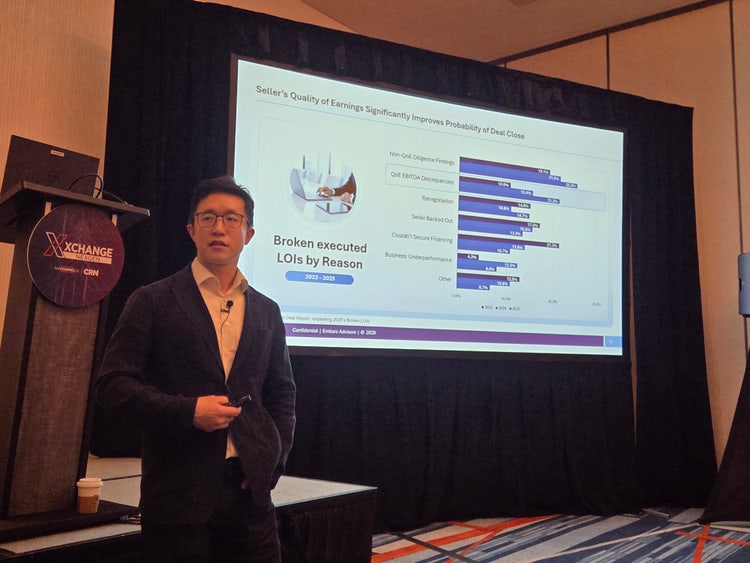
MSPs preparing for a sale could be leaving a substantial amount of money on the table by failing to conduct a quality of earnings analysis before going to market.
A QoE can cost tens of thousands of dollars, and company buyers usually conduct their own QoEs on the selling company, Jay Jung, founder and managing partner of West Hollywood, Calif.-based Embarc Advisors, told a room of MSPs Sunday. But the selling company could add another 35 percent to their EBITDAs through a full QoE. And a seller running a QoE can avoid missing add-backs.
“If you don’t do your own QoE, you don’t know what your true adjusted EBITDA is,” Jung said. “That’s basically selling a house without knowing what the square footage is.”
Jung spoke as part of CRN parent The Channel Company’s XChange NexGen conference in Orlando, Fla., which runs through Tuesday.
[RELATED: Halo Pushes MSPs Into The Era Of Predictive IT]
He added that “discrepancy in EBITDA is one of the top reasons deals fall apart after you go on their LOI (letter of intent)”—even more often than renegotiations, sellers backing out, an inability to secure financing and business underperformance.
Allen Falcon, CEO and co-founder of Westborough, Mass.-based Cumulus Global—a 2026 CRN MSP 500 honoree—told CRN in an interview that he used Jung’s services when exploring a sale and, even though the deal didn’t go forward, he found the process worthwhile.
After analyzing his business, Falcon said he has been able to run it with a greater focus on value, with profitability following more quickly.
“The benefit of doing the sell-side QoE was getting a very objective, honest third-party evaluation of our business: what’s working, what’s not,” Falcon said. “But it also indicated that there were things we were focused on that weren’t adding value. In fact, they were detracting. And it helped us realign our focus and our strategy.”
How A Quality Of Earnings Analysis Can Boost MSP EBITDA
Jung—who has more than $50 billion in completed transactions under his belt from his time with Goldman Sachs and McKinsey & Co. and worked on the sales of Yahoo to Verizon, MuleSoft to Salesforce and SanDisk to Western Digital—said that a critical move to help MSPs avoid undervaluing themselves is running a quality of earnings (QoE) analysis on the validity and sustainability of company profits.
For Embarc-run QoEs, the firm looks at the last three years of an MSP’s financials and puts everything on an accrual basis, which business buyers prefer. The firm leaves out non-recurring events like one-time consulting costs and litigation.
“There’s a lot of low-hanging fruit,” Jung said. “No wonder private equity loves to gobble up middle-market companies because there’s so much money to be made right off the bat.”
This year, Embarc has helped to sell six MSP companies that ranged from $500,000 EBITDA up to $3 million EBITDA, Jung said. The firm also works with MSPs buying companies.
For MSPs buying other solution providers, QoEs can help reduce acquisition risk.
“If you’re buying a ($)300,000 EBITDA or ($)2 million topline MSP, they’re not in good shape,” Jung said. “If they were, they would have grown a lot faster. So a lot of people buying those businesses, they see the opportunity. They see how they’re going to grow that better. How they’re going to clean up that better. How they’re going to improve margin or dollar-per-seat better. So usually they see opportunities.”
MSP Valuations: Look Beyond The Average Multiple
Other advice Jung shared included not being constrained by industry-average multiples and, once a sale looks likely, considering Qualified Small Business Stock (QSBS) treatment to potentially reduce federal taxes.
He used the example of a company he worked with that received 11 bids with a median multiple of six times EBITDA, but the individual bids put the multiple from 3.6 times EBITDA up to 8.2 times.
“One of the big mistakes that people make is they hear these multiples in the market, and then when they get the market average multiple, they’re content,” Jung said. “And they say, ‘Oh, I got a good multiple.’ That’s another big mistake because you could get a much higher multiple.”
MSP owners need to show more than revenue, net income, cash in the bank and EBITDA, Jung said.
They need to show lower risks through monthly recurring revenue (MRR), retention rates, multiyear contracts, employee tenures and other measures.
And they need to show higher growth rates through measures like new leads per month, average revenue per deal and new customer close rates.
And for MSPs concerned about too-low growth, he’s still seen solution providers growing 5 percent to 10 percent still achieving decent multiples.
On QSBS, Jung said it’s possible to pay no federal capital gains taxes under the benefit, and MSPs are a qualifying business category for the benefit.
Qualifying for QSBS means founding or investing in a small business that is less than $75 million and structuring the business as a C corporation for more than five years, he said.
Although MSPs sometimes don’t like structuring as a C corp because they pay taxes twice—through the business and then personally—whereas S corporations and limited liability companies (LLCs) pay once, changes to QSBS under the One Big Beautiful Bill Act that passed in 2025 create a tiered stock structure for C corps.
Under that structure, C corp MSPs can see a 50 percent gain exclusion after three to four years, 75 percent gain exclusion after four to five years and 100 percent after five-plus years.
Jung said that rumors that private equity firms don’t like stock deals and that they will discount stock deals are unfounded in his experience.
“People do not spend enough time preparing for a sale,” Jung said. “They’re so eager to run out and start talking to buyers.”
Jung’s comments reflect an overall channelwide attention to earnings quality rather than size, with Abe Garver, managing director and MSP team leader at Focus Investment Banking, recently telling CRN that the channel is in a seller’s market. Kevin Damghani, founder and CEO of ITPartners+, recently told CRN that MSPs can command higher multiples through vertical expertise in another example of solution provider valuation strategies.