‘Those Who Got You Here Won’t Get You There’: One MSP Exec On Scaling, Culture And CEO Burnout
‘I kept hearing vendors on stage saying, ‘I’m a recovering MSP,’’ says Marissa Maldonado, co-founder and CEO of Proda Technology ‘After hearing it three, four, five times, I realized something was wrong with our mindset as a whole. How can someone tell me how to run my business while describing the experience of running one as if it were a disease?’
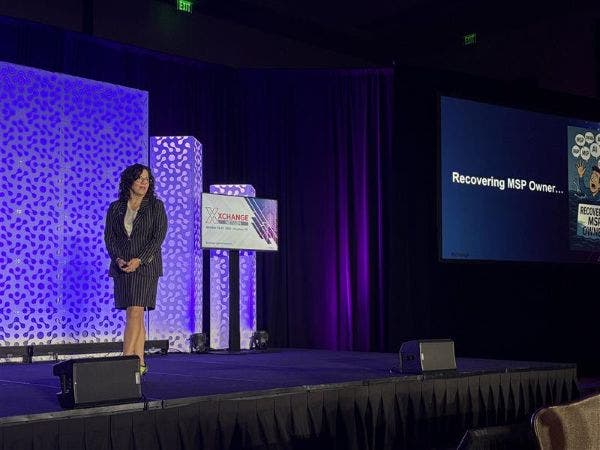
When Marissa Maldonado first entered the MSP industry, she expected to find mentors — people who could share how they’d grown their businesses. Instead, she found something else: an identity crisis in an industry that often describes success as something to “recover” from.
“I remember walking into those first networking events and saying, ‘Hi, I’m Marissa Maldonado. I have an MSP. We’re at $5 million,’” she said. “And people would be shocked. It was because I was an over-$5 million MSP and no one in the room had ever told me how to get there.”
Maldonado, co-founder and CEO of Atlanta-based Proda Technology, spoke to a room full of MSP executives at CRN parent company The Channel Company’s XChange NexGen conference in Houston last week.
At the networking event she recounted from the stage what stood out to her most were the comments from industry veterans.
“I kept hearing vendors on stage saying, ‘I’m a recovering MSP,’” she said. “After hearing it three, four, five times, I realized something was wrong with our mindset as a whole. How can someone tell me how to run my business while describing the experience of running one as if it were a disease?”
[Related: Solution Provider Exec Says Consistent Messaging Is Key: ‘Sing The Same Song Your Content Does’]
That mindset, one that equates growth with burnout, is what she hopes to change. “We need to stop saying we’re ‘recovering’ and start saying we’re proud. This journey isn’t trauma. It’s proof of strength and resilience.”
Her journey began in her brother’s basement in Atlanta. “He told me, ‘I built myself a job. I’m leaving deals on the table. Do you want to turn this into a company?’ I said, ‘Absolutely.’”
Those early days as an IT consulting firm were chaotic as she recalled wearing all the hats of the business including accountant, engineer and office administrator.
“We got audited and even had a tax lien. I lived on an air mattress for a year,” she said. “My parents, who immigrated from Mexico and Puerto Rico, were begging me to stop. But I was stubborn.”
That stubbornness, she admitted, became her greatest strength. By focusing on Microsoft 365 consulting and embracing operational discipline, the business began to scale. She and her brother realized their niche, leaned into it and rode the wave. “Sometimes success is just about showing up again and again, no matter how hard it gets.”
But as the company grew past $3 million in revenue, Maldonado hit another wall: leadership.
“If I stopped, the business stopped. That was the identity crisis,” she said. “I had to stop being the hero and start building a business that made money even when I wasn’t in the room.”
But that shift didn’t come easily. She hired an in-law, but he soon turned his back on her and the clients. “That was the first time I realized that not everyone would grow with me.”
The lessons continued as the company climbed to $5 million in revenue and beyond, the company implemented an EOS (entrepreneurial operating system) system, hired a COO and built a leadership team.
Throughout these changes, she learned a very valuable lesson.
“Those who got you here won’t always get you there,” she said. “I had to let go of people, even family. I had to measure culture, track turnover and hold leadership accountable. Culture isn’t this fuzzy concept, it’s data.”
Maldonado’s company is now approaching $10 million in revenue, she said she has a two-year goal to reach it, and is focused on empowering her team, automating processes and re-engaging her visionary side.
“Founder burnout is real,” she said “You hire people to build systems and suddenly those systems feel like walls. But if you trust your team and free yourself from the grind, you can innovate again.”
Her message to the MSP community was simple: stop glorifying the struggle and start celebrating the milestones.
“We celebrate billion-dollar companies, why not the $3 million or $5 million ones? That’s where the real transformation happens,” she said. “Each stage of growth is supposed to feel hard. It’s not about it getting easier, it’s about building resilience and systems that let you work smarter. We’re not recovering MSPs. We’re proud ones. We’re the protectors of small and midsize businesses across our allied countries. That’s something worth celebrating.
“So the next time you hear someone say they’re a recovering MSP, I want you to ask them, ‘What if you’re not recovering? What if you’re just getting stronger?’” she added.
Brazil-based Luisa Balaniuc, who’s held leadership positions at multiple MSPs, said Maldonado’s talk mirrored challenges she’s faced throughout her own career.
“When she said the CEO is involved in everything and needs to put their pride aside to hire people who can take the company to the next level, that hit home,” she told CRN. “I’ve been in those situations before, where the person who got you from zero to one isn’t the person who can take you from one to 10.”
And she praised Maldonado, saying it’s important to be transparent but optimistic
“She was so real about the stages of growth and what she learned at each one,” she said. “It’s such a good reminder that you can be honest and kind at the same time. Also, when she said, ‘Give me two years to get to $10 million,’ I was like, ‘Girl, you can do it faster. I believe it.’”