Nvidia CEO Explains Why He Sees ‘Something Very Different’ From An AI Bubble
In arguing against comparisons to the dot-com bubble that led to the stock market crash in 2000, Jensen Huang says on Nvidia’s earnings call that the AI infrastructure giant is benefiting from ‘three massive platform shifts’ happening at once.
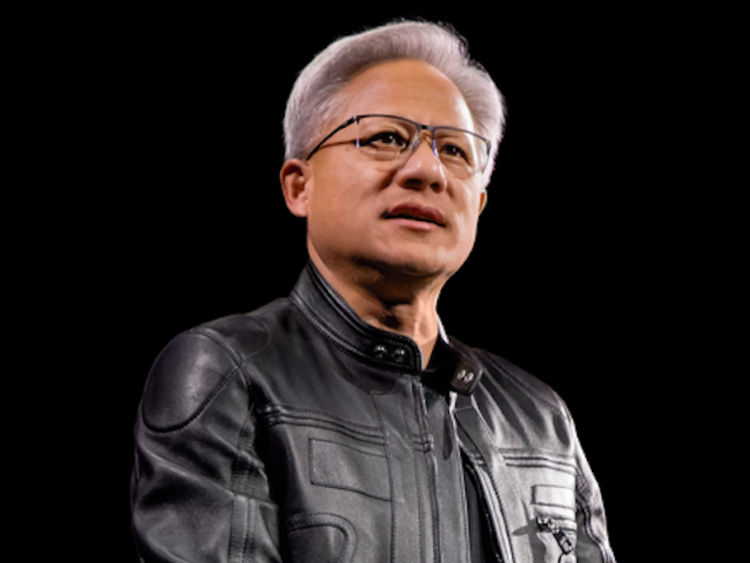
Nvidia CEO Jensen Huang took on the popular question of whether his company is at the center of an AI bubble Wednesday and said he sees “something very different” that will “contribute to infrastructure growth in the coming years.”
In arguing against comparisons to the dot-com bubble that led to the stock market crash in 2000, Huang said on his company’s earnings call that the AI infrastructure giant is benefiting from “three massive platform shifts” happening at once.
[Related: AMD Sees ‘Very Clear Path’ To Double-Digit Share In Nvidia-Dominated Data Center AI Market]
“The first time since the dawn of Moore's law, Nvidia is uniquely addressing each of the three transformations,” he said, referring to Intel founder Gordon Moore’s observation that the transistors on a computer chip will double every two years.
Huang made the remarks after his company reported that third-quarter revenue grew to a record $57 billion, marking a 62 percent year-over-year increase that was largely driven by sales of the company’s Blackwell and Blackwell Ultra GPU platforms.
On the call, Nvidia CFO Colette Kress reiterated recent remarks by Huang that the company has “visibility” to $500 billion in revenue from the beginning of this year to the end of next year for its Blackwell and next-generation Rubin platforms. The company expects the AI infrastructure market to reach up to $4 trillion by the end of the decade.
With the company continuing to experience fast sales growth of its products and platforms for AI data centers, Huang spent the first few minutes of his earnings call appearance to explain why the massive infrastructure investments announced by Nvidia’s customers and partners over the past few years for AI development do not represent a bubble.
In addressing the tech industry’s three platform shifts that are pointing to sustained growth, Huang said the first is the ongoing transition from general-purpose computing, made possible by CPUs, to accelerated computing enabled by GPUs and other accelerator chips.
Reiterating his oft-mentioned point that Moore’s law is slowing down, Huang said that previously CPU-bound applications—including those for data processing and simulation—are “rapidly shifting” to take advantage of Nvidia’s GPUs through its CUDA programming platform.
“Secondly, AI has also reached a tipping point and is transforming existing applications while enabling entirely new ones for existing applications,” he added. “Generative AI is replacing classical machine learning in search ranking, recommender systems, ad targeting, click-through prediction [and] content moderation.”
To support his point, Huang pointed out how Meta reported a 5-percent increase in ad conversions on Instagram and a 3-percent gain on Facebook in its third quarter thanks to Meta’s Generative Ads Model, which is trained on large-scale GPU clusters.
“Transitioning to generative AI represents substantial revenue gains for hyperscalers,” he said.
To Huang, the third shift is focused on agentic AI and physical AI, which he said “will be revolutionary, giving rise to new applications, companies, products and services.”
Pointing to companies adopting agentic AI features, he cited coding assistants like Cursor and Quadcode, radiology tools like Aidoc, legal assistants like Harvey and autonomous taxis from the likes of Tesla and Google-owned Waymo.
“The fastest-growing companies in the world today—OpenAI, Anthropic, xAI, Google, Cursor, Lovable, Replit, Cognition AI, OpenEvidence, Abridge, Tesla—are pioneering agentic AI,” Huang said.
Earlier in the call, Colette said that physical AI “is already a multibillion-dollar business, addressing a multitrillion-dollar opportunity and the next leg of growth for Nvidia.”
Huang claimed these shifts to accelerated computing, generative AI, agentic AI and physical AI will not only continue but accelerate over time to benefit the economy.
“As you consider infrastructure investments, consider these three fundamental dynamics. Each will contribute to infrastructure growth in the coming years,” he added.
“Nvidia is chosen because our singular architecture enables all three transitions and does so for any form and modality of AI across all industries, across every phase of AI, across all of the diverse computing needs in a cloud, and also from cloud to enterprise to robots [with] one architecture,” Huang said.
With Nvidia now into its second year of its annual release cadence for data center GPUs and related products, Huang said Nvidia’s impact on the economy will grow over time.
This is thanks to the “co-design” work it does across its hardware and software portfolio, “across the frameworks and models, across the entire data center, even power and cooling optimized across the entire supply chain in our ecosystem,” according to the CEO.
“And so [with] each generation, our economic contribution will be greater, our value delivered will be greater, but the most important thing is our energy efficiency—per watt—is going to be extraordinary every single generation,” he said.