Salesforce Revamps Slackbot: 5 Channel Takeaways
Here are five takeaways for solution providers on new opportunities with Slackbot and what Salesforce’s investments in agent orchestration signal for the future.
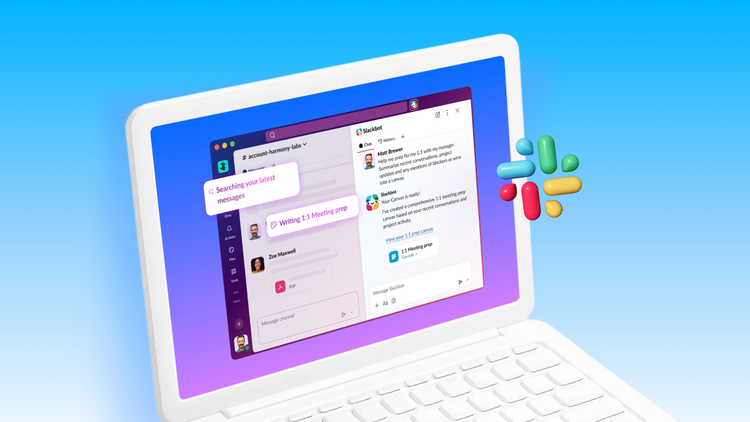
Salesforce has a host of upgrades coming for its revamped Slackbot virtual assistant, including increased access beyond Business+ and Enterprise+ plans this month and automatic provisioning and connection for all new Salesforce customers sometime in the summer.
Salesforce co-founder and CEO Marc Benioff told a group of reporters after this week’s Slackbot event that just about every AI company that started in the last three or so years is built on Slack, including OpenAI and Anthropic, showing the power of the platform Salesforce bought about five years ago to go beyond a collaboration tool to a full unified interface for the AI era.
“What I see is this incredible innovation machine,” Benioff said.
[RELATED: Claude Maker Anthropic’s Channel Strategy Takes Shape: 5 Things To Know]
Here are five takeaways for solution providers on new opportunities with Slackbot and what Salesforce’s investments in agent orchestration signal for the future.
30-Plus New Slackbot Capabilities Unveiled
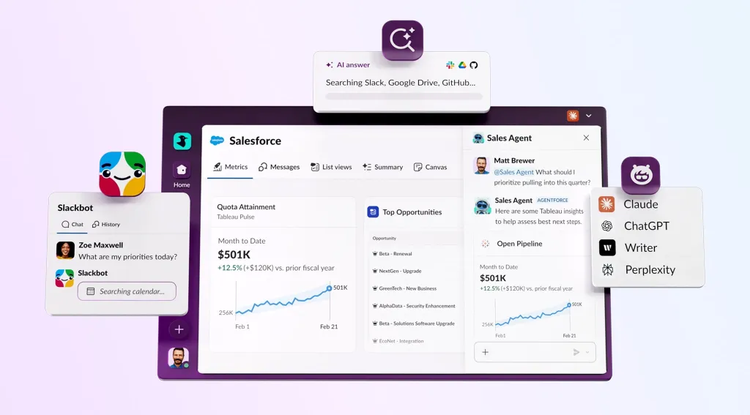
Salesforce revealed more than 30 new capabilities released in Slackbot, with one of the biggest updates leveraging Model Context Protocol (MCP) to route work or prompt questions to Agentforce or any application or agent in the enterprise. That includes 2,600-plus applications in Slack Marketplace and 6,000-plus apps in AppExchange.
Salesforce bills this capability as allowing employees to ask Slackbot to do something without needing to know which system handles the task.
Among the capabilities becoming generally available in May are AI skills that allow Slackbot to turn repeatable work into reusable AI capabilities. Instead of users writing prompts and rebuilding workflows from scratch, they can package a skill, save it to a canvas and share across the organization. Deep research can exhaustively research a topic before a meeting, for example.
Memory allows Slackbot to learn users’ preferences, workflows, shortcuts and other ways they work, even down to preferred emojis based on who the user talks to and whether the user prefers making slides in Google Drive or OneDrive.
Capabilities entering preview in June include intelligent notetaking, which has helped Salesforce product design and engineering teams, according to the vendor. On desktop, Slackbot will securely view work on screen to bridge the gap between what the user sees and what the user needs to do. Slackbot will respond to the user’s request, execute the update in Slack without hijacking controls or leaving the workspace, keeping humans in control. This can work with design files, decks, browsers and inboxes on the desktop.
Slackbot can summarize, draft follow-ups, provide status updates on actions in a document and other actions based on what’s viewable on a user’s desktop. Slackbot for desktop adoption should be easy for the tens of millions of Slack desktop application users with nothing new to install or configure.
Slackbot voice input will transcribe words, understand intent and execute work in business applications. Voice-to-CRM logging allows representatives to update records through quick mobile conversation, according to Salesforce.
Already generally available is agentic prospecting, where agents can research information online, in call recordings and serve users a list of prospects. Engagement agents can send personalized messages to leads, answer questions and book meetings with sales representatives. Pipeline management agents can look at conversations and updates and orchestrate revenue without manual Salesforce updating.
Fight For The User Interface Amid ‘SaaSpocalypse’ Concern
Salesforce and other SaaS vendors have faced an existential threat from AI upstarts like Anthropic and OpenAI that show an ability to quickly jump into various complex technology product categories.
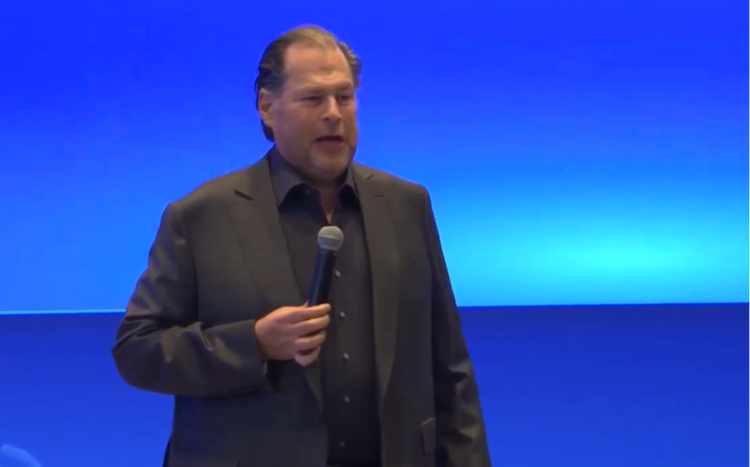
However, Benioff (pictured) and others in the space have pointed to decades of relationships and hosting the data that powers AI tools as strong competitive moats.
Slack may be one of Salesforce’s most strategic assets for this AI cycle should the SaaS industry becomes “headless”—that is, it no longer needs a user interface and just contains business logic—but users still want a way to execute work with natural language, investment firm TD Cowen said in a report Wednesday.
Making Slack the gateway for organizational AI makes sense because it is a place where knowledge workers interact and because Slackbot can coordinate calendars and applications across everyone in the channel plus send automated notes during meetings, according to a Tuesday report by KeyBanc. Slackbot’s ability to exist outside Slack on a desktop and interact with third-party apps—including spreadsheet apps, a hole in the Salesforce productivity suite—is a powerful weapon.
Salesforce is positioning Slackbot as a single, unified interface for the enterprise and a “front door” for an organization’s technology stack, cutting down the number of dashboards.
Slackbot can route user requests to specialized AI agents, manage a multistep workflow—coordinating with applications like DocuSign to pull contract information, for example, with context from enterprise data already in Slack and other Salesforce products—and present a final handoff to the user.
The Slack platform becomes an agentic work operating system, unifying every application and AI agent into a conversational interface.
Slackbot represents Salesforce investing more in AI orchestration capabilities that competitors including Microsoft have also dove into with offers like Agent 365.Slackbot operates as a way to orchestrate workflows once context-aware agents are integrated into Slack so that users focus more on outcomes and completing work than managing a series of tools, according to the vendor.
Salesforce calls orchestration the final stage of an agentic workspace, saving users the complexity of remembering the specific tasks a particular agent handles.
SMB, Enterprise Workflows
One benefit of Slackbot that might interest Salesforce solution providers is the ability to generate cross-domain execution of AI agents.
That cross-domain execution should help drive accelerated adoption and monetization of AI consumption inside the company’s products, TD Cowen said in a report Wednesday. The investment firm also commended the early list of Slackbot integration partners from Anthropic and Google Gemini to Perplexity and Cursor and Slackbot’s potential to accelerate adoption of first-party Salesforce agents and third-party ones. Slack has grown tenfold year on year in AI users.
Slack CRM might be especially notable to Salesforce solution providers working with small businesses. Slack CRM—which is included in Slack Business+ plans—with Slackbot can replace contact management systems, according to Salesforce. Slack CRM can access contact information through application integration with Slackbot capturing the information and details in channels and discussions to update records.
This move should give small businesses a small taste of CRM functionality, eventually leading to growth and expansion into the full product suite, TD Cowen said in its Wednesday report. It also helps Salesforce better compete against HubSpot and others in the SMB space.
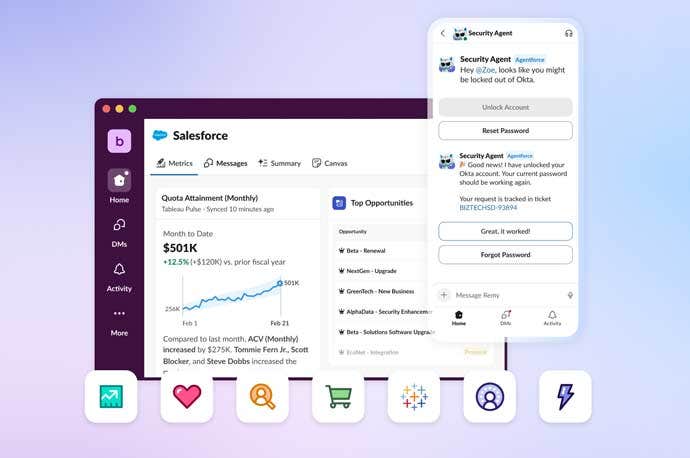
For Salesforce solution providers working with enterprise clients, Slackbot has become the conversational interface for Customer 360. Users can update opportunities, research accounts, route cases and trigger workflows through plain English in Slackbot without opening any Salesforce application.
The cross-selling potential for solution providers includes new Tableau MCP integrations allowing for real-time quota attainment in the same flow, for example.
During Salesforce’s most recent quarterly earnings report in February, the vendor disclosed that its Slackbot AI-powered personal agent has more than 350 AI applications and agents in its marketplace.
Salesforce reported 1 million Slack customers. The company also said it has consumed nearly 20 trillion tokens, converting them into more than 2.4 billion agentic work units to date across Agentforce and Slack. That token count is up fivefold year on year, and that agentic work unit milestone is up 57 percent quarter on quarter.

AI’s Privacy, Compliance Imperative
During a press conference after this week’s Slackbot event, Benioff was asked whether security, privacy and compliance remain barriers to AI adoption. The CEO said “there is no finish line on security. There's no finish line on privacy.
“It’s a constant battle in our industry, and we build more and more of that into our products,” he said. “For our customers, who are the largest, most important companies and governments in the world, we have to start at the privacy and security barrier, if you will. And then that’s what gives us our competitive advantage over time.
“For every one of these AI companies, they have to get to another level of safety and standards,” Benioff said. “Just in the same way that we’ve seen some very dark moments for social media, we're starting to see those moments for AI as well, and it’s extremely important for every company to double down on their ability to make us safe.”
Partner Program Shift: Incentives For The Agentic Era
Salesforce updates have not only been contained to AI product innovation, with the vendor also looking to align solution providers to the agentic era.
Earlier in March, Salesforce published a blog post about evolving the consulting track of its Partner Program to emphasize not just traditional implementations but move consulting partners to a verifiable customer outcome metric for success.
Salesforce’s partner ecosystem leads 70 percent of Agentforce implementations, according to the vendor. For every $1 of Salesforce revenue, partners should generate $6.19 in value now and $6.83 in 2028. Global AI IT spend should reach $816 billion by 2028.
The vendor targets $1 billion in partner-influenced annual contract value for the current 2027 fiscal year, with partner rewards for lead submissions, presales activity incentives and post-sales implementation subsidies for agent activation and consumption. Before, the consulting partner program focused more on presales incentives.
Salesforce has also planned twofold to sixfold increases in certification vouchers and hands-on verification requirements to make sure solution providers can architect and deploy AI agents in high-stakes enterprise environments with security and compliance met.
Solution providers receive expanded access to demonstrative environments, internal use licenses, product insight, training and other resources. New partner dashboards and bulk upload tools should also help solution providers streamline operations, remove manual friction and provide better project record visibility.
Partners now receive payouts linked to active consumption instead of seat provisioning. The partner program takes 170 legacy “navigator” distinctions to 28 core competencies aligned with Agentforce and Data 360.
Solution providers can earn these competencies based on customer satisfaction scores, project outcomes and certifications in 28 product and industry specialization areas. Solution providers with competencies receive enhanced discovery in the AppExchange marketplace. AppExchange has about 23 million annual views, according to Salesforce.
Salesforce also provides two levels of partner recognition: Accredited for demonstrated capabilities and Expert for scaled delivery excellence, according to the vendor.
As part of the changes, Salesforce is moving down from four consulting partner tiers to two: Summit for top-tier, strategic growth partners and Select for delivery partners who meet performance standards.
Partners should have an easier time navigating scorecards and incentive calculations. Partners are now measured by customer satisfaction scores, specializations and competency certifications as indicators of results, moving away from manual checklists, according to the vendor.