Broadcom Is Driving ‘More Innovation’ Than Ever At VMware After Hock Tan’s ‘Tough Decisions,’ Says VMware’s Leader
“When Broadcom acquired VMware, the talk was, ‘Oh, VMware is dead. Innovation is dead. Nothing will come out.’ And in fact, more innovation came out faster after VMware was acquired than VMware ever produced in the past,” VMware’s general manager, Krish Prasad, tells CRN.

VMware leader Krish Prasad says Broadcom is driving innovation faster than ever at VMware, as seen with its launch of VMware Cloud Foundation 9.0, as Broadcom CEO Hock Tan needed to make “some tough decisions” following Broadcom’s acquisition.
“When Broadcom acquired VMware, the talk was, ‘Oh, VMware is dead. Innovation is dead. Nothing will come out.’ And in fact, more innovation came out faster after VMware was acquired than VMware ever produced in the past,” said Prasad, senior vice president and general manager of Broadcom’s VMware Cloud Foundation Division.
Prasad, a longtime VMware executive who currently leads Broadcom’s VMware innovation and business strategy, said Broadcom CEO Tan spearheaded efforts to solve customers’ complaints around needing a platform versus point products.
“Customers were complaining all the time, ‘Why aren’t we delivering a platform?’ And we never could, because of the structure,” Prasad said. “The first thing that Hock did during the integration of the acquisition was to fix that. … Hock has shown us that he is willing to invest.”
[Related: Like It Or Not, This Is Broadcom’s New VMware Channel Strategy]
One smashing success from Broadcom’s $61 billion acquisition of VMware in late 2023 was the creation of VMware Cloud Foundation 9.0 (VCF 9) private cloud platform.
“Hock made some tough decisions, but we needed to rethink how we were set up,” said Prasad. “You have to understand, we are not selling individual point products anymore. We are now selling a platform for the private cloud.”
VCF 9 has now set VMware up to attack the public cloud market to offer an end-to-end private cloud platform that has better total cost of ownership (TCO) and technologies, Prasad said.
“Businesses are starting to bring some of the applications that shouldn’t have gone to the public cloud in the first place, back on-prem,” he said. “When you bring some of these applications back, [customers] expect the same kind of experience back on-prem. So that’s what VCF 9 is going to help our customers do: deploy on-prem and give a public cloud like experience to their developers.”
In an in-depth discussion with CRN, Prasad talks about VCF versus the public cloud, VMware’s innovation roadmap and how Broadcom is changing VMware for the better.
Your competitors say VMware’s innovation will lack under the large Broadcom umbrella. Do you think that’s true or does Broadcom help VMware innovation?
When Broadcom acquired VMware, the talk was, ‘Oh, VMware is dead. Innovation is dead. Nothing will come out.’ And in fact, more innovation came out faster after VMware was acquired than VMware ever produced in the past.
In fact, one of the things that we were able to do is we organizationally changed the structure of the groups within VMware. We put it all together so we could create this platform very fast.
In VMware, everything was organized as different silos, different divisions—everything was a different division. Every division has its own general manager.
We were trying to put it all together but the priorities were all different and we couldn’t line up everything.
Customers were complaining all the time, ‘Why aren’t we delivering a platform?’ And we never could because of the structure. The first thing that Hock did during the integration of the acquisition was to fix that.
We now have one division, which is the VCF division, where we brought all the pieces. So one R&D team saying, ‘Let’s go build.’
That’s why we were able to deliver VCF 9 that is all integrated.
So decisions get made. That decision was never made in VMware for years. The customers were complaining. Then it was just—’boom’—done. So we were able to move fast.
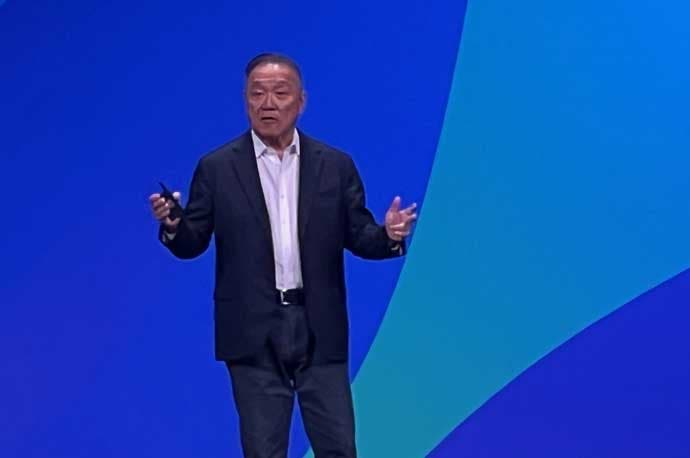
How are Hock (pictured) and Broadcom reshaping VMware?
The one thing that we all got coming from VMware into Broadcom is Hock is very good at focusing on a few things and doing it well.
VMware was a little bit more scatterbrained and doing multiple things. So the focus has helped us move very fast.
We announced VCF 9.0 in the last year and we delivered VCF 9.0 a few months after that. So we are able to execute really well.
Broadcom also has a $1.5 trillion market cap. Broadcom is able to invest and to do the kind of innovations that came out in VCF 9.0. VMware previously, we would have never had the focus, as well as the investment to do it.
The market cap of VMware versus the market cap of Broadcom—there was no way VMware could have invested at the levels that Broadcom can invest in.
What Hock has shown us that he is willing to invest. For example, there’s like 400 or 500 new capabilities that came out in VCF 9. It’s a huge release.
Did VMware need someone like Broadcom to take it over?
VMware was a company that was established and was running a certain way. It had different divisions. That was the history of VMware. Everything was a different division.
So how the revenue was accounted for, how we broadcast to the market, etc.—all of that was by these different groups.
It’s very hard to change, because that was the structure of the company in terms of how we talk about revenue and all that kind of stuff. But when you go through an acquisition, everything is from a clean slate.
Hock made some tough decisions, but also, we were able to make those decisions because we went through an acquisition and almost started with a clean slate again.
It’s not that VMware management didn’t want to do that.
It was a tougher thing to do when everything in the company is running a certain way, and how you report revenue to the market, everything is a certain way with all these different business units.
You could say the acquisition happened at the right time. We needed to rethink how we were set up and all of that, and the acquisition itself, allowed us to do that.
How can VCF be a main driver for public cloud repatriation to on-premise VMware?
So businesses are starting to bring some of the applications that shouldn’t have gone to the public cloud in the first place, back on-prem.
But some of them will remain in public cloud. It’s not a question of, ‘Now everything is leaving the public cloud.’ That’s not the message.
People are being much more judicious about what should go where and for what reasons.
So when these applications come back, one of the things that the public cloud has done really well is set the operating model, the cloud operating model.
So that has become the thing that developers love in terms of their agility and flexibility and all of that. So when you bring some of these applications back, they expect the same kind of experience back on prem.
So that’s what VCF 9 is going to help our customers do: deploy on-prem and give a public cloud like experience to their developers. We have tons of customers going to VCF.
Is there any specific application or workload where you’re seeing more traction of people leaving public cloud for a hybrid or private cloud? Is there any low hanging fruit?
Yes, any application that has a lot of chat with the backend in your IT department, like all the backend systems and mainframe and all of that.
Applications are very complex. It talks to multiple things. Some go all the way back to the enterprise back end of the mainframes and all of that.
When you have that kind of chatter between the application you’re running in the cloud with something that is sitting in your enterprise IT back-end, it costs you a lot of money because the ingress of the data going back and forth.
There is no reason for the data to fly back and forth, just put it close to where the data needs to be.
On the other hand, if you have like a web portal that end users use and you want to make it available across the world in all the regions, then Amazon has data centers everywhere. You can host those front-end websites.
That’s an application that should remain in the cloud and take advantage of the regional distribution of the data centers, but a lot of the mission critical applications that are much more in the corporate backend, there’s no reason to send all the data back and forth to the cloud and pay all the money. So move that back on-premise.

As VMware says public cloud bills are spiraling out of control for customers, how did we get here?
If you rewind a few years when the public clouds first started happening, the developers found it very easy and agile. They could just start, get a server, do some work—it’s like in one minute, I’m off and running.
That was the attraction to the public cloud. So the initial momentum was started from the development side, with the app developers feeling like, hey, ‘They are able to be more agile with the public cloud than with the private IT infrastructure that they had.’ Then a lot of applications then started moving, customers had this public-cloud-first mission. The hype cycle was on its upswing.
However, people started realizing in the last couple of years that the cost was not what they expected. The cost was spiraling out of control.
In fact, in any enterprise you go to today, there is a CFO-level project to say, ‘How can we cut down on the public cloud spend?’ It is there across the board.
It is spiraling out of control partly because of the cost of the cloud, partly because there was no control in ‘What goes where? It was not thought through. They would say, ‘Everything goes right to the cloud.’
Now customers are taking a step back and saying, ‘Hey, there are more efficient ways to manage our infrastructure.’ It doesn’t mean that everybody’s leaving the public cloud. That’s not the message. They are being much more judicious in terms of, ‘Why do we need a particular thing in the public cloud?’ Versus ‘What can we deliver on-prem to balance the cost?’ That’s what is happening today.
Talk about the VMware product portfolio and how VMware partners need to sell VCF today to win over customers?
Hock made some tough decisions, but we needed to rethink how we were set up. You have to understand we are not selling individual point products anymore. We are now selling a platform for the private cloud.
The world has moved on from customers trying to cook up their own infrastructure with all the ingredients, ‘I’ll buy this technology and that technology. I’ll stitch it all together, and I know what I’m doing.’
Those things have ended up in a disaster and never delivered the TCO benefits of the operational efficiency that customers were expecting.
So customers now are saying, ‘Hey, don’t give me the ingredients. Give me a platform that I can deploy and get to a cloud as quickly as possible.’ That’s what they’re expecting.
If they’re not, then partners need to educate them on what’s happening in the industry and how people are leaving aside all the stitched together homegrown solutions to something that is out of the box, that is architected to deliver the same experience that AWS gives from a public cloud to their end users.
That’s the same thing that you can deliver to your end users by deploying the VCF-based private cloud.