Google CEO On Gemini 4, Allocating TPUs, AI Models And Gemini Enterprise
CEO Sundar Pichai explains Google’s TPU allocation strategy, huge Gemini Enterprise momentum, upcoming Gemini 4 release and much more.
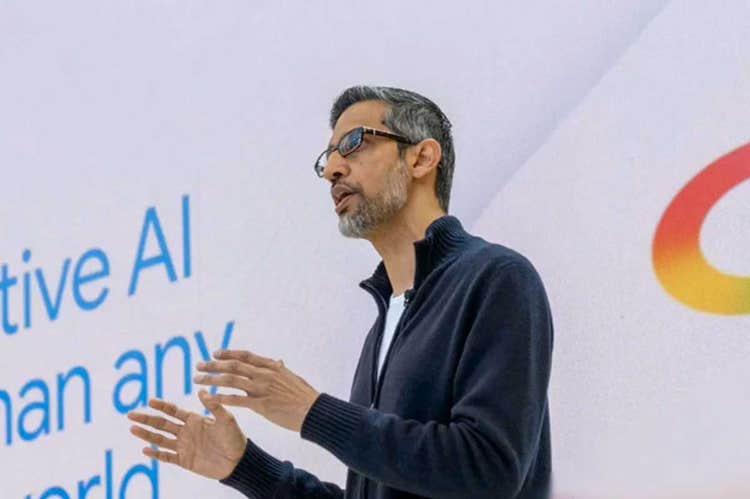
Google CEO Sundar Pichai took a deep dive into its upcoming Gemini 4 launch, Gemini Enterprise momentum, Google Cloud sales growth, AI model plan and how the tech giant plans to allocate TPUs.
“Cloud revenue grew 82 percent, powered by strong demand for AI infrastructure and AI solutions, and cloud backlog grew to $514 billion,” said Pichai last week during Google’s second quarter financial earnings report.
“It’s great to see the wide adoption of Gemini Enterprise, with nearly 90 percent of the Fortune 100 using it,” he added.
Mountain View, Calif.-based Google generated $120 billion in total revenue during Q2 2026.
Google Cloud revenue soared 82 percent year over year to $24.8 billion, up from $13.6 billion in Q2 2025.
[Related: The 10 Coolest Semiconductor Startups Of 2026]
Before jumping into the boldest remarks made by Google’s CEO, here’s a quick look at one of the company’s hottest enterprise offerings: Gemini Enterprise.
Google Gemini Enterprise Momentum
Google’s Gemini Enterprise is a workplace AI platform and agentic AI system that unifies data, custom AI agents and Google’s advanced AI models. It enables users with generative AI and agentic workflows by leveraging data sources from across an organization with prebuilt connectors for popular third-party applications included.
Promevo is a Google Cloud Premier partner that’s a top provider of Gemini Enterprise solutions.
Promevo CTO John Pettit said clients are buying Gemini Enterprise at a rapid pace since it makes “it possible for customers to build no-code agents” as well as having third-party connectors.
“It also creates a secure landing zone for employees to use AI against their corporate data, which is not something that you see through all the other commercial offerings without building up a lot of security scaffolding or other things like that to keep the data protected,” Pettit said.
“So it creates an interesting opportunity for people to roll it out to all of their employees and still feel safe,” he said. “So if I’m a CIO or a CSO, I’m not worried about data leakage or data loss. Where with the other systems, if I start connecting it into my Google Drive, I have to worry about, ‘Where is that data going? Is it still staying secure? Is it grounded correctly?’ So they’ve created a unique solution with Gemini Enterprise.”
Promevo, for its part, recently launched a new suite of Gemini Enterprise offerings around operationalized AI agents and Google Cloud AI services.
“Right now, Gemini Enterprise has around 6 million registered users. So there’s just a large population of people that you can expose your application to and find new ways to monetize,” said Pettit.
Here’s what Google’s CEO said about Gemini Enterprise, TPUs, AI momentum, and much more.
90 Percent Of Fortune 100 Using Gemini Enterprise
One of the strongest parts of our growth comes from the rapid adoption of our Gemini Enterprise platform.
It’s great to see the wide adoption of Gemini Enterprise, with nearly 90 percent of the Fortune 100 using it.
We have customers like PepsiCo for AI and analytics solutions, Intel to streamline core processes, HSBC for wealth management, Bell Canada for customer engagement, Macy’s for commerce experiences, and Signal Iduna for knowledge management.
It is differentiated with easy-to-use tools to build agents and automate processes, connectivity to enterprise systems, cost management, and governance tools.
More broadly, Gemini is transforming how millions of businesses use AI to build custom agents, automate processes, improve cybersecurity, manage customer relationships, streamline data analytics, collaborate effectively and more.

Google’s Allocating TPUs Strategy
In terms of allocating TPUs, our first priority is making sure we are allocating what we need to compete at the frontier in terms of AGI [artificial general intelligence] development.
So that is the foundation for everything we do.
But given the extraordinary demand to balance the external demand, even for most cloud customers, we are using both TPUs and GPUs mainly for serving our models.
So think Vertex AI, Gemini Enterprise, agentic workloads, analytics and cybersecurity, etc. So we are using it for those purposes.
To the extent people want it as infrastructure, we are balancing it by increasingly looking at opportunities to put TPUs in their data centers, or in other data centers, like the project we are doing with Blackstone.
So we are using that as an ability to balance and make sure we are allocating as much of the available compute for frontier model development, as well as serving both our consumer business and our enterprise business in terms of first‑party models.
Google Cloud New Customers; ‘More Than Doubling Our Acquisition Velocity’ With Cloud Marketplace Growing 7X
Cloud revenue grew 82 percent, powered by strong demand for AI infrastructure and AI solutions, and cloud backlog grew to $514 billion.
Gemini continues to be a key driver of growth, and is deeply integrated across all of our Cloud products, including Gemini Enterprise, Data Analytics, Cybersecurity, and Google Workspace.
We are seeing strong, diversified demand across products, customers, geographies, and industries.
Our product differentiation is driving expansion in three ways.
We’re winning new customers, more than doubling our acquisition velocity year-over-year.
We’re deepening our relationships with existing customers, who are expanding their usage and exceeding their commitments by more than 50 percent, also an acceleration over last quarter.
We are driving growth with partners, with transactions on Google Cloud Marketplace growing over seven times year-over-year.
Google Is Currently Training Gemini 4
In terms of the frontier [models], we are both very committed and very confident of being at the frontier. For the next generation of frontier, you’re going to need much larger base models.
We are now training Gemini 4, and we’re being very ambitious with it.
I am very excited by the progress I’m seeing internally on Gemini 4, and I’m confident that people will be pleased when we are putting it outside.
But we will need Gemini 4 as a larger base model to compete at that frontier model, and so we are focused on executing on that path.
We are really focused, putting a lot of effort into Gemini 4. It’s a very ambitious effort.
We want to compete at the frontier level of where the frontier will be when Gemini 4 comes out. So we are applying a lot of our compute and effort in that direction.
Gemma Models ‘Downloaded Over 900 Million Times’
Our Gemma family of open models, small enough to run on local devices, are hugely popular.
These models have been downloaded over 900 million times.
And our latest Gemma 4 models have been downloaded over 300 million times since launching in April.
Our agentic development platform Antigravity allows anyone to build in the agent‑first era. It has more than 2.4 million weekly active users.
Antigravity is a powerful tool for users and enterprises, and it’s completely accelerated how we build internally. As just one example, a team in Chrome is now on track to accelerate delivery by eight times, compressing a two‑year timeline into three months through model‑driven refactoring.
Google Cloud Security And Wiz Momentum
We are seeing strong interest in our AI-powered security platform, which is differentiated because it integrates threat intelligence, cyber-response prioritization with Wiz, AI-automated scanning, code remediation, and monitoring.
Today, 90 percent of the Fortune 100 are Google Cloud Security users.
Nearly 90 percent of Wiz customers are using AI-powered security features.
And we have seen a more than 45 percent quarter-over-quarter increase in the number of AI workloads scanned and protected by our security platform.
Our security tools are being used to protect critical infrastructure, including financial services organizations such as Morgan Stanley; telecommunication providers such as Telus; healthcare organizations such as Texas Children’s; software companies such as Atlassian; and several government agencies.
And with our new Google AI Threat Defense, we’re really excited to bring our new cyber model and CodeMender to help our customers defend against AI threats.