Analysis: AMD Puts Channel Pressure On Intel As Both Firms Revamp Partner Programs
In a sign of AMD’s growing channel prominence, the chip designer beat Intel in CRN’s 2025 Annual Report Card for the first time since the feature introduced a processor category 22 years ago. The company is now making big moves with a restructured partner program.
When AMD earlier this year revealed that it boosted partner funding by 40 percent this year, the chip designer made clear that it underwent a cultural reset, endorsed by top leadership, to ramp up pressure against Intel in the channel.
That pressure became more apparent when AMD beat Intel in CRN’s 2025 Annual Record Card (ARC), which is based on scores given by solution providers to vendors on matters ranging from product innovation to support and partner program resources.
[Related: Qualcomm Channel Leader To Exit After Helping Build Snapdragon X Partner Program]
It was a significant achievement for AMD, which won in the CPU category against Intel for the first time since ARC introduced a processor category in 2003.
As detailed in this year’s breakdown for the ARC CPU category, AMD won with an overall score of 74.8 against Intel’s 66.6. Just last year, Intel won with an 81.5 over AMD’s 80.5. (Note: The ARC CPU category is not to be confused with Intel’s Arc GPU products.)
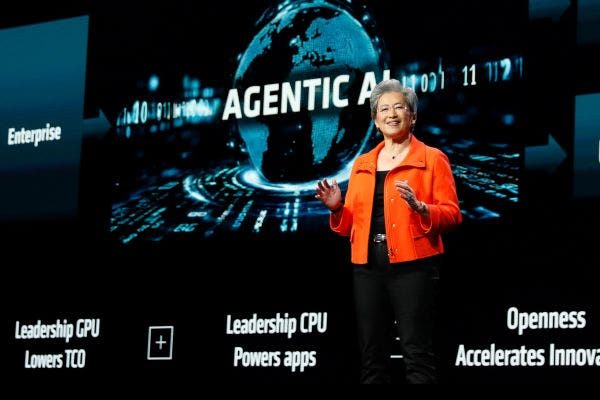
The chip designer, led by AMD Chair and CEO Lisa Su (pictured), managed this year to beat Intel in every ARC category, achieving an average score of 100.3 in product innovation against Intel’s 97.3, an average of 65.6 in support against Intel’s 55.1 and an average of 75.6 percent in partnerships against Intel’s 64.5.
It was AMD’s win in the latter category that is most telling of the company’s efforts to compete with Intel more effectively in the channel. Last year, Intel beat AMD with an average score of 79.1 for partnerships in contrast to rival’s 73.9.
Christopher Cyr, CTO of North Sioux City, S.D.-based systems integrator Sterling Computers, told CRN on Monday that he has noticed a clear improvement in how AMD works in the channel this year, echoing comments by other partners.
“I’ve seen a real difference this year versus the following years,” said Cyr, whose company, which partners with multiple silicon providers, won an Intel Americas partner award last year and is No. 54 on CRN’s 2025 Solution Provider 500 list.
How AMD Is Ramping Up Competition In The Channel
It’s well known at this point that AMD has flourished over the past several years due to the success of its Ryzen and EPYC CPUs, which have shown to be just as good if not better than Intel’s competing chips in many cases.
But up until this year, the Santa Clara, Calif.-based company had struggled with creating a partner program that can ably compete against Intel, particularly in the commercial PC and server markets. After all, this has been one of Intel’s traditional strengths, which has benefited from decades of investment and channel buy-in.
Jason Mooneyham, who became AMD’s global commercial channel chief in January, admitted to CRN in a June interview that a previous iteration of the company’s commercial program that debuted in 2022 wasn’t enough to move the needle against Intel.
That’s because the program at the time mainly revolved around a volume incentive rebate in addition to some MDF and training elements.
“It wasn’t a program. It was a volume incentive rebate. Let’s call it what it was,” he said.
Over time, Mooneyham and his team realized that AMD should do more to enable partners to sell AMD’s products because of how critical the channel is to reaching commercial customers, particularly the midmarket and SMB segments.
“Our growth in large enterprise has been fantastic, but in order to get to that customer below large enterprise […] we have to turn this channel on in a major way, in a much more improved way. It couldn’t just be status quo,” he said.
As a result, the company launched its restructured commercial partner program, called the AMD Partner Network, in October with a 40 percent increase in its overall channel investment budget, which includes funding for sales incentives, new strategic programs and marketing funds.
Among the enhancements for the new program, AMD is introducing special rebates for things like AI PCs and Windows 11 refresh that partners can stack on top of the traditional volume incentive rebate. The company has improved its training program for partners too by working more closely with its business units.
The company is also expected to increase its global partner coverage by roughly 20 percent and nearly double its channel staff by the end of the year. There were more than 500 value-added resellers, distributors, service providers and systems integrators on its roster in the first quarter, and that number reached 520 by October, according to AMD.
Mooneyham told CRN that the feedback he had received from AMD’s closest partners was that the new program is “not just competitive but best-of-breed in a lot of areas.”
“Does that mean we’re the best across the board? Probably not. But we also constantly solicit feedback on ways we can improve it,” he said back in June.
How Intel Is Trying To Fight Back
Against this more competitive backdrop, Intel has emphasized that partners will get “more value” and “more benefits” as part of a “simplified” Intel Partner Alliance program that the company launched the same month as the rival’s AMD Partner Network.
The semiconductor giant made several changes to its partner program, including the move to a two-tier member system and more ways for partners to earn additional points, as it undergoes a larger transformation led by Lip-Bu Tan, who became Intel’s CEO in March.
Andy Marsee, general manager of Intel Partner Alliance, emphasized in an August interview with CRN that no partners will lose benefits as a result of Intel moving partners from the program’s traditional three-tier system that consisted of Member, Gold and Titanium tiers to a two-tier system that consists of the base Partner and premium Prestige tiers.
He called this Intel’s “no partner left behind” mantra.
“Whether you were Gold or whether you were a Member in the current structure, in the new structure you’re going to get more benefits [and] more value, even if you’re in that second Partner tier,” Marsee said at the time.
As part of the restructured program, the company also announced marketing-related changes, such as a new outcome-based MDF model going into effect next year and the availability of Intel’s brand to top-tier partners for co-marketing purposes.
These changes happened as the parent division of Intel’s global partner organization, the Sales and Marketing Group, eliminated many marketing roles and outsourced those roles to global consulting giant Accenture. The marketing layoffs happened as part of a broader 15 percent reduction in the company’s workforce over the summer.
While Intel remains under pressure to complete a comeback plan that began under former CEO Pat Gelsinger and is now being led by Tan, Cyr, the CTO at Sterling, said the increased competition from AMD will incentivize the larger rival to fight back.
“What I think is cool about all of this is that, in a way, it’s going to revitalize Intel,” the solution provider executive said, noting recent positive developments like the reveal of Intel’s upcoming “Panther Lake” chips for PCs. “They know that they’re still in the fight, and they know that there are things that still make Intel great.”