Intel Shares Details Of Forthcoming Intel 18A Chips Key To Its Comeback
The forthcoming Panther Lake and Clearwater Forest chips represent the first to use the semiconductor giant’s Intel 18A advanced chip-making technology. The company has banked a great deal of the future success of its design and manufacturing businesses on Intel 18A.
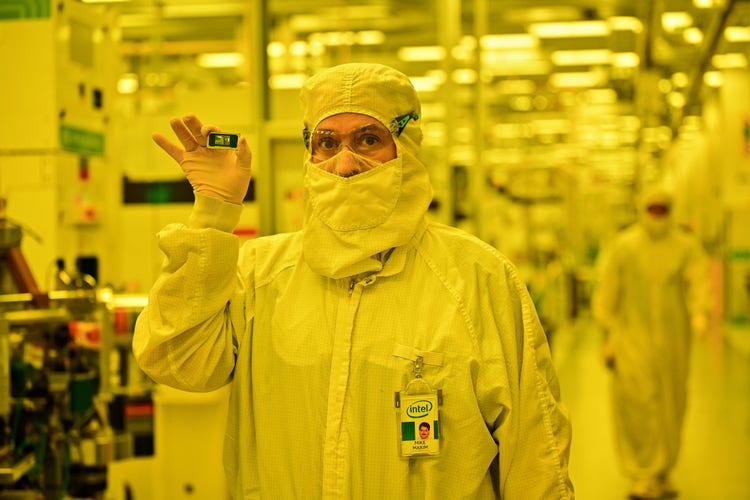
Intel on Thursday shared a variety of details about its forthcoming “Panther Lake” PC system-on-chip and “Clearwater Forest” server CPU—two products that represent a critical and long-awaited step in its heavily scrutinized comeback plan.
The Panther Lake and Clearwater Forest chips represent the first to use the semiconductor giant’s Intel 18A advanced chip-making technology, which the company said will deliver 15 percent better performance per watt and 30 percent improved chip density compared to the last-generation Intel 3 node. Early production has begun in Oregon, with the company now ramping up high-volume manufacturing in Arizona.
[Related: Analysis: After Big Nvidia Win, Will Intel Ever Escape Its Rival’s Shadow?]
The chipmaker has banked a great deal of its future success on Intel 18A, which will be used for at least the next three generations of Intel’s client and server chip products. The process was first pitched by former Intel CEO Pat Gelsinger in 2021 as the last step in a multi-node plan to regain process performance leadership and build a competitive contract chip manufacturing business against Asian foundry giant TSMC.
However, Intel admitted in late July that the contract chip-making business, Intel Foundry, does not yet have “significant external” customers, warning that it may “pause or discontinue” development of future leading-edge nodes if it’s unable to land a major customer for Intel 18A’s successor, Intel 14A.
While Intel’s new CEO, Lip-Bu Tan, explained at the time that this warning is part of a “new financial discipline” he has instituted for the company’s manufacturing investments, he expressed optimism that the worst-case scenario won’t play out for Intel Foundry.
Tan, who joined Intel in March, said Intel “will be in a better position to attract external customers” to Intel 18A “once we get our own product ramping in high volume.” He added that the company has “learned quite a lot” from the mistakes it made on Intel 18A and is now applying those lessons to Intel 14A.
The company’s new disclosures about Panther Lake, expected to ship later this year under the Core Ultra series 3 brand, and Clearwater Forest, which is set to launch in the first half of next year with the Xeon 6+ brand, provide the most detail yet about the performance and efficiency capabilities that are made possible by Intel 18A.
How Panther Lake Compares To Lunar Lake, Arrow Lake
Mainly designed for laptops, Lunar Lake will feature up to 16 CPU cores, 12 GPU cores and 180 trillion operations per second (TOPS) across the entire system-on-chip, with the CPU providing a maximum of 10 TOPS for light AI workloads, the NPU offering up to 50 TOPs for persistent AI workloads like assistants and the GPU supporting up to 120 TOPS for heavier gaming and content creation AI workloads, according to the company.
The system-on-chip will also support up to 96GB of LPDDR5 memory and 12 lanes of PCIe Gen 5 connectivity as well as integrated Intel Wi-Fi 7, dual Intel Bluetooth Core 6 and integrated Thunderbolt 4 connectivity. In addition, it will feature enhanced Intel Thread Director and power management technology.
Intel did not disclose clock speeds for Panther Lake.
Compared to the Core Ultra 200V chips formerly known as “Lunar Lake,” Intel said Panther Lake will deliver greater than 10 percent better single-threaded CPU performance and more than 50 percent better multi-threaded CPU performance—both at similar power levels.
The company also boasted of Panther Lake featuring greater than 40 percent more NPU TOPS per area than Lunar Lake, whose NPU maxed out to 48 TOPS.
In addition, Intel said that Panther Lake will require more than 30 percent less power than the Core Ultra Series 2 desktop chips formerly known as Arrow Lake to provide a similar level of multi-threaded CPU performance.
At a system-on-chip level, Panther Lake will use up to 10 percent lower power than Lunar Lake and as much as 40 percent less power than Arrow Lake.
Panther Lake will feature Intel’s new Couger Cove performance core (P-core) and Darkmont efficiency core (E-core) technologies. These cores will sit alongside the new IPU 7.5 image signal processor and NPU 5 processor as well as the Xe media and display engines on a compute tile manufactured on Intel 18A as part of Panther Lake’s chiplet design.
The system-on-chip will also use Intel’s new Xe 3 GPU architecture on a separate tile, but whether it’s manufactured by Intel or another company depends on the performance level. For Panther Lake models with up to four GPU cores, the GPU tile will use the Intel 3 node. But for models with up to 12 GPU cores, the GPU tile will be fabricated by an external chip manufacturer that Intel did not name.
The company has previously said that it uses TSMC for multiple products.
How Clearwater Forest Compares To Sierra Forest
Representing the second generation of Xeon CPUs with E-cores, Clearwater Forest is being touted by Intel as “the most efficient server processor the company has ever created.”
Compared to the Xeon 6 “Sierra Forest” processors that launched last year, Clearwater Forest provides a 17 percent boost in instructions per clock per core, doubles the maximum core count to 288, increases last-level cache by more than five times to 576 MB and offers 20 percent faster memory speed of up to 8,000 MT/s for DDR5.
The new Clearwater Forest processors will also increase the number of memory channels by four to a total of 12 and up the UPI links by two to a total of six. Other features include up to 96 lanes of PCIe 5.0 connectivity, up to 64 lanes of CXL 2.0 connectivity.
Intel did not disclose clock speeds for Clearwater Forest.
Designed for single- and dual-socket servers, Clearwater Forest will feature a thermal design power that ranges from 300 watts to 500 watts. The processors will be socket-compatible with Sierra Forest platforms.
Security features will include Intel Software Guard Extensions and Intel Trust Domain Extensions. For power management, Clearwater Forest will use Intel Application Energy Telemetry and Intel Turbo Rate Limited.
For acceleration, the processors will feature Intel Advanced Vector Extensions 2 for 8-bit integer calculations and up to 16 integrated accelerators, split evenly between Intel QuickAssist Technology, Intel Dynamic Lead Balancer, Intel Data Streaming Accelerator and Intel In-memory Analytics Accelerator.
Compared to the 144-core Xeon 6780E Sierra Forest processor, Clearwater Forest is expected to deliver up to 90 percent higher performance. The upcoming processor line will also feature up to a 23 percent improvement in efficiency across the load line.
As part of Intel’s ongoing data center consolidation push, the company said Clearwater Forest will enable data centers running on second-generation Xeon CPUs to consolidate servers by a ratio of eight to one. It said such a move would improve the data center’s performance per watt by 3.5 times and reduce space used by 71 percent.
Like Panther Lake, Clearwater Forest will be a chiplet design, with the compute tile using Intel 18A, the active base tile using Intel 3 and the I/O tile using the Intel 7 node. The compute tile uses the same Darkmont E-core technology as Panther Lake.