‘A Kinder Kaseya’ Emerges Under CEO Rania Succar
‘Everything we’re doing is about helping MSPs succeed. That’s our mission. That’s who we are under my leadership. We’re a high-velocity, customer-obsessed company, and we’re just getting started,’ says Rania Succar, CEO of Kaseya.
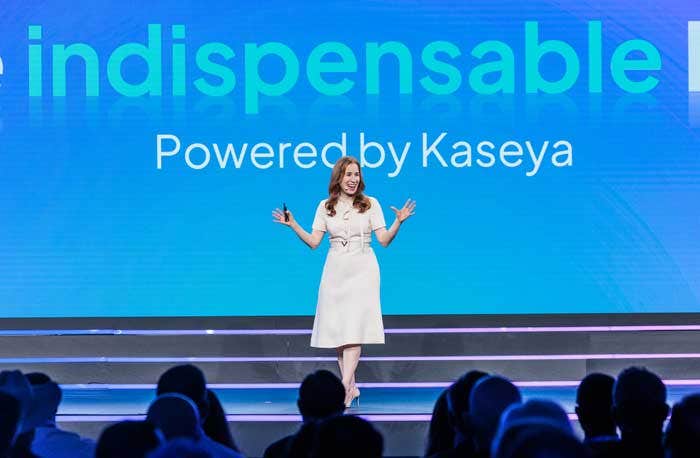
The Kaseya DattoCon 2025 event came with the trappings of theater—the swirling lights, the booming music—all building anticipation for a series of announcements designed to be crowd-pleasers: a new backup device, billing updates, agentic AI-powered automation features, the acquisition of email security vendor Inky.
Each new revelation at the conference, held in October in Kaseya’s hometown of Miami, garnered ardent applause from the audience.
But there was more.
After a round of applause would subside, shouts and cheers from individual attendees—“Thank you!,” “Woo!,” “Yeah!”—rang out from all corners of the room, reactions signaling that partners believe the moves Kaseya is making will translate directly to solving their pain points.
This perhaps comes as no surprise to Rania Succar, who joined MSP platform vendor Kaseya in June after nine years at Intuit, most recently as head of the Intuit Mailchimp marketing platform business. Since coming on board, she has had a singular focus.
[READ MORE: Kaseya CEO On Doubling Down On MSP Growth: ‘A Frictionless—and Delightful—Experience]
“Everything we’re doing is about helping MSPs succeed,” Succar told CRN in an interview at the event. “That’s our mission. That’s who we are under my leadership. We’re a high-velocity, customer-obsessed company, and we’re just getting started.”
And she has laid out a clear directive for her team moving forward.
“I want every feature we launch to be tied to MSP revenue growth or margin expansion,” she said. “That’s how we measure our success.”
While Kaseya has long been known for its customer-centric approach, there were opportunities to improve, she said.
“Innovation starts with customer feedback, but it doesn’t end there,” she said. “It’s also about what our technologists see as possible. Our teams look at the assets we already have, dream bigger and ask, ‘What if we could deliver more impact than customers are even asking for?’ That’s where the magic happens.”
Under Succar’s guidance, Kaseya is taking steps to improve the experience for its MSP partners.
“We’re investing in automating internal processes, from billing to on-boarding to support, to make the experience more frictionless and delightful,” she said. “We’re building technology that eliminates the need to ask for help because the right help shows up exactly when and where it’s needed.”
MSPs using its platform and employees of Kaseya said they see the evidence of the renewed customer-first approach since Succar stepped into the CEO role, succeeding Fred Voccola, who transitioned to vice chairman of Kaseya’s board several months ahead of her appointment.
Voccola had spent the last decade as the outspoken voice of the company, leading Kaseya through a dramatic transformation to become a dominant MSP platform vendor. He accomplished that in part through a series of savvy acquisitions, including IT Glue in 2018, ID Agent in 2019 and—most significantly—rival Datto for $6.2 billion in 2022.
But the company under his leadership was also polarizing, seemingly earning as many loyal fans as sharp detractors. Those who criticized the company focused on its reputation for utilizing hard-nosed sales tactics, letting development of its acquired products languish and making it difficult for customers to shut off services.
The dissatisfaction with Kaseya was perhaps most evident after its Datto acquisition, which many in the channel saw as a clash of cultures as the socially conscious, MSP-first, publicly held Datto was absorbed by its new private-equity-held owner. The billing issues that Kaseya admitted to in October 2023 that impacted 8 percent of its partners in the wake of the Datto acquisition only exacerbated the problem.
Now Succar is putting her own stamp on the company.
“Fred was relentless, intense,” said Gray Knowlton, executive vice president of product at Kaseya. “He pushed us hard, but always in service of [the] mission. Rania brings that same drive, but it’s filtered through strategy, empathy and long-term vision. She’s not softer; she’s just different. And that difference is starting to show in how customers interact with us.”
‘The Tone From The Top Is Shifting’
Over the years, Corey Kirkendoll has seen the value Kaseya provides to his business simply through M&A deals. Three tools in Kirkendoll’s stack, IT Glue, Datto and now Inky, have all been acquired by Kaseya.
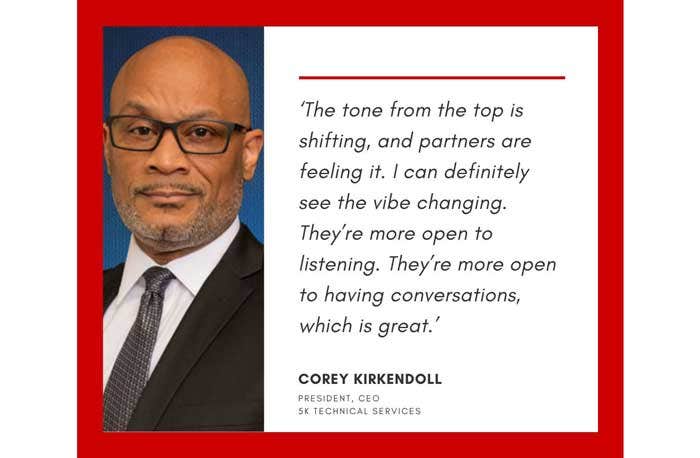
“They’re validating my stack,” Kirkendoll, president and CEO of Plano, Texas-based 5K Technical Services, said with a laugh. “Every time I pick a tool, they buy it. It’s like, ‘Yup, I’m doing something right.’”
But outside his tech stack, Kirkendoll is seeing a shift in how Kaseya shows up for MSPs. After years of what many MSPs saw as a culture of aggressive sales methods and underwhelming product innovation, change may finally be in the air at Kaseya, he said.
“The tone from the top is shifting, and partners are feeling it,” he said. “I can definitely see the vibe changing. They’re more open to listening. They’re more open to having conversations, which is great.”
He said conversations with his account rep have shifted as well, not only in tenor but in timing. While he would typically hear from his rep toward the end of the month looking simply to make a sale, now he chats with the rep more frequently—and it’s not just a sales pitch.
“They’re checking in early: ‘How can I help? What’s going on?’” he said. “They’re coming with real options. I’m seeing people talk differently. The sales meetings are calmer. They want to build relationships again, not just close deals.”
Antwine Jackson, president and founder of Raleigh, N.C.-based Enitech, is also seeing a shift, from how Kaseya’s sales teams interact with partners to the company’s focus on AI and community- building. Kaseya, he said, is maturing and starting to align more with the needs of MSPs than ever before.
“There’s a new level of seriousness,” Jackson told CRN. “You’re seeing a kinder Kaseya. Not softer—kinder. More focused on partnership, more interested in community and more open to real feedback.”
What stands out most to Jackson is the tone shift, one he’s not only hearing from executive announcements but also feeling in his day-to-day interactions, “It’s gentler. Less transactional. And that’s something we haven’t seen in a while.”
[READ MORE: Kaseya Chief Product Officer Jim Lippie: ‘AI Will Redefine MSP Efficiency Through Automation’]
During the DattoCon conference, Jackson said he and other MSPs attended a dinner with the company’s CRO, Anthony Anzevino, who joined Kaseya in September.
Jackson said the CRO sat at his table and asked him and the other MSPs directly, “How can we serve you? What can we do better?”
“That is not the Kaseya of old,” Jackson said. “That kind of face-to-face engagement shows they’re serious about changing.”
The Pain Of Change
The changes Succar is making don’t come without discomfort.
On Oct. 23, about two weeks after Succar spoke to CRN for this story, Kaseya—whose majority investor is private equity behemoth Insight Partners—confirmed that it had laid off 200 employees as part of what it called a “focused investment strategy to align resources with the areas that will deliver the greatest impact.”
In a statement supplied to CRN when the layoffs came to light, Kaseya said the decisions made reflect the company’s “ongoing commitment to operating efficiently, investing with urgency in innovation and ensuring resources are directed toward strategic priorities that drive customer success.”
Enitech’s Jackson said the layoffs are emblematic of the fixes Succar is still working to make.
“Does this change my opinion of Rania’s leadership and what she’s doing now? No,” Jackson said. “I think she’s trying to fix some of the things that were already broken. It’s no different than when a new president comes in, they have to deal with what the previous administration left behind. She’s taking care of issues that were already in motion and working to restructure and realign the organization.”
The focus on realignment comes seven months after the company refinanced $4 billion in debt to strengthen its balance sheet, improve liquidity and free up resources to reinvest in innovation and customer experience initiatives. The refinancing, according to a Kaseya spokesperson, has improved Kaseya’s financial flexibility.
“It was completed back in March, and it actually delivered meaningful cost savings,” the spokesperson told CRN of the refinancing, which was first revealed in February when Bloomberg reported Kaseya was working with Morgan Stanley to sound out investors. “Overall, it strengthened our capital structure. We’ve been able to take those savings and reinvest them in areas that directly enhance the customer experience and support our long-term growth initiatives.”
The company is profitable, the spokesperson said, noting that it currently generates $1.5 billion in annual recurring revenue with EBITDA margins in the high 30s.
“We’ve been profitable for many years,” the spokesperson said. “We continue to grow both the top line and the bottom line pretty substantially. Kaseya’s financial position is very strong. It gives us the flexibility to continue making significant investments in innovation and enhancing our products to ensure our customers get a world-class experience.”
CRN also reported Oct. 13 that the recent DattoCon conference will be the last held in the U.S. as it shifts that content to its flagship Connect event in Las Vegas, making that its primary large North American event going forward.
“We will incorporate the best elements of DattoCon into the program in Las Vegas,” a spokesperson said via email at the time. “We will also continue investing in the large events that fuel our peer groups and our local events.”
In addition, Kaseya is taking steps it says will protect the intellectual property it purchased via its Datto acquisition. It filed a lawsuit in September against backup and recovery software maker Slide for misappropriation of intellectual property, alleging that the company—co-founded by Austin McChord, the founder and former CEO of Datto—hired engineers who worked at Datto to build “copycat offerings that leverage Datto’s proprietary technologies.”
In legal filings, Slide countered that Chairman McChord and his team respect intellectual property and hired engineers who developed a next-generation backup and recovery application from the ground up.
Kaseya is seeking an injunction against Slide to prevent the company from selling its backup product, as well as several forms of unspecified monetary awards.
‘Protect The MSP’s Role In Every Deal’
Regardless of how the legal wranglings play out, Kaseya channel chief Dan Tomaszewski said Kaseya’s shift in energy and direction is palpable, from big-picture strategy to day-to-day execution.
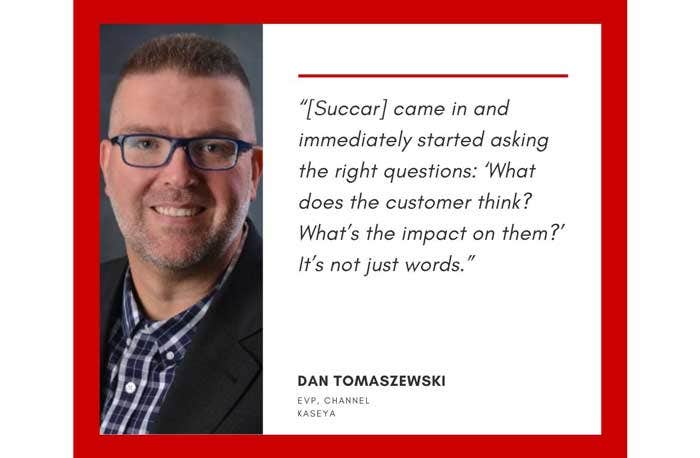
“[Succar] came in and immediately started asking the right questions: ‘What does the customer think? What’s the impact on them?’” Tomaszewski, executive vice president of channel at Kaseya, told CRN. “It’s not just words. She’s investing in things that will actually make a difference, like giving us a better community platform, more resources for enablement and the backing to make those customer-centric ideas come to life.”
Customer feedback, he said, has always been part of the Kaseya playbook, but what’s different now is how that feedback is being acted upon. At DattoCon, Tomaszewski met with more than 100 partners to gather feedback, but the shift now is in how that feedback is put into action.
“The difference now is that Rania is listening in real time, and she’s actually deploying teams and resources to fix what needs fixing. It’s all coming from the top,” he said.
That top-down buy-in is critical to the company’s ability to build community and support MSP growth, he said.
“It’s not just buying a platform or tool. That’s easy,” he said. “It’s the actual doing that matters and getting the C-suite involved, making sure all levels of leadership are aligned and engaged. We’re seeing that now.”
He added that Succar has been clear that making it easier for MSPs to do business with Kaseya is her top priority. “She wants to remove the friction and protect the MSP’s role in every deal. That’s the most attention I’ve seen on this issue in nearly eight years.”
When Succar was first named CEO, Kaseya Senior Director of MSP Enablement Matt Scully and product chief Knowlton weren’t sure what to expect.
What they’ve experienced in the months since she came on board has been a shift not just in leadership style, but in culture, community investment and the way Kaseya engages with its MSP partners.
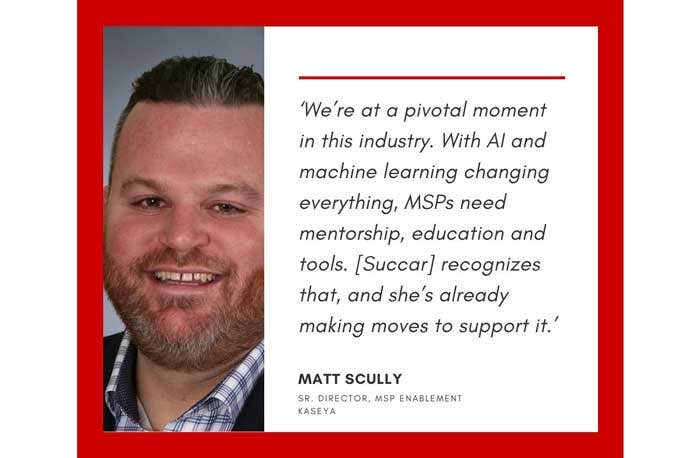
Scully said that Succar’s keynote at DattoCon spotlighted how the CEO is working to simplify the customer experience and putting a stronger focus on AI and enablement.
“We’re at a pivotal moment in this industry. With AI and machine learning changing everything, MSPs need mentorship, education and tools,” Scully told CRN. “She recognizes that, and she’s already making moves to support it.”
And it’s been meaningful for Kaseya’s product teams to see that Succar views the world through such a strategic lens, according to Knowlton.
“Rania came in, and from day one she started solving problems,” said Knowlton. “She’s deeply familiar with small business, understands how to turn a set of tools into a unified platform, and she’s constantly thinking about what the end user is going to experience.”
Every meeting is now framed around the customer and its pain points, said Knowlton, who joined Datto in 2021 and came to Kaseya through the acquisition. “Fred was very execution-driven. Rania is much more strategy-driven and reflective. She leads with questions and helps the team find the best path forward. It’s empowering.”
The tone of conversations with MSPs has also changed, as employees say the culture now feels more open.
“People are saying, ‘We’re seeing a different Kaseya,’” said Scully, who worked for Datto from 2015 to 2020 and then joined Kaseya in 2023. “There’s a more human approach, a sense that we’re not just listening but actually moving on what we hear. And internally, I’ve never been happier. I’ve been with the company on and off for almost a decade, and the alignment, the execution … it’s never felt stronger.”
From Succar’s standpoint, Kaseya’s culture should be goal-oriented, cross-functional, collaborative and empowering, and it starts with ownership.
“I don’t see constraints as constraints,” she said. “I set bold goals. Then we work backwards, action by action by action, to get there.”
Kaseya Will Be ‘Central To The AI Revolution’
Change for the company is also accelerating when it comes to AI innovation. Kaseya has begun rolling out AI assistants to support staff, with plans to embed intelligent chatbots directly into its products. But the real opportunity, Succar said, is in measuring and delivering on the efficiency through the power of AI.
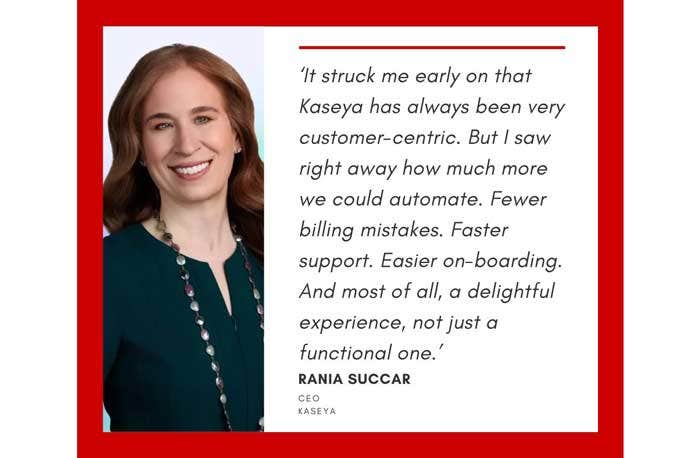
“It struck me early on that Kaseya has always been very customer-centric,” she said. “But I saw right away how much more we could automate. Fewer billing mistakes. Faster support. Easier on-boarding. And most of all, a delightful experience, not just a functional one.
“Our goal is to document MSP workflows, then eliminate repetitive tasks through automation,” she added. “We’re going to track exactly how much time we’re saving them, and we’ll be accountable for those results.”
The company’s AI-first approach plays a huge part in documenting and analyzing MSP workflows. Going forward, Kaseya is hiring more AI talent and investing in research and development to find ways to make MSPs even more efficient.
“We are actively hiring, especially in [research and development],” she said. “But we need AI-native talent, people who’ve evolved how they work, who are comfortable with change and who are excited to solve hard problems quickly.”
Solution provider Michael Goldstein, who’s on Kaseya’s CEO Advisory Council, said AI isn’t just a buzzword with Kaseya, but rather something that could be deployed through the integrated tools that span the full suite of its offerings.
“Everyone’s doing AI, but Kaseya owns so many of the top MSP tools already so they can integrate AI across everything, and that’s a huge advantage. You don’t need a dev team to stitch things together,” said Goldstein, president and CEO of Fort Lauderdale, Fla.-based LAN Infotech.
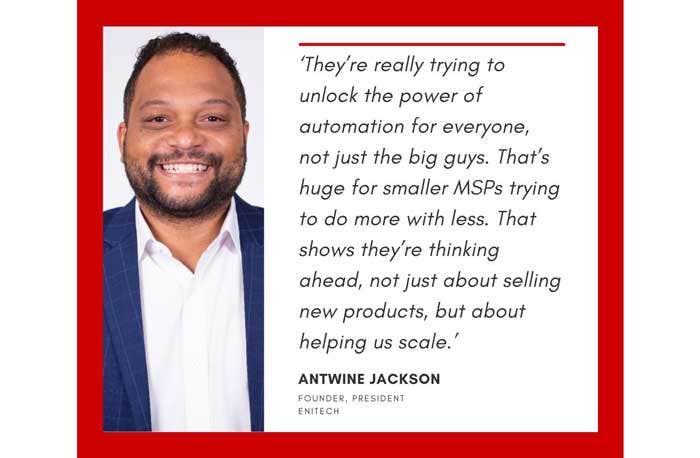
Enitech’s Jackson said he’s also seeing the push toward AI, and not just at the surface level.
“They’re really trying to unlock the power of automation for everyone, not just the big guys,” he said. “That’s huge for smaller MSPs trying to do more with less. That shows they’re thinking ahead, not just about selling new products, but about helping us scale.”
Succar said Kaseya is working to cement its position as an AI leader.
“We’ll be known as one of the most important innovators for small businesses globally,” she said. “We’ll be central to the AI revolution. And MSPs will say, ‘We couldn’t have done it without Kaseya.’”
A New, Energized Kaseya
Succar’s focus, Goldstein said, seems to be translating into measurable action, which he said has made “a significant impression” in just these few months.
“She’s crawling before she runs,” he said. “She’s not overpromising, and she’s delivering on what can be done today. That builds confidence, especially with those who were skeptical or even outright negative in the past.”
One of the most impactful outcomes under Succar will be Kaseya’s MSP enablement side of the house. Greg Jones, Kaseya’s senior vice president of MSP enablement, teased big changes coming to the Global Partner Program centering on education, enablement and business transformation.
“You’ll see more sales training, more strategic support and more alignment with the real challenges MSPs are facing, like hiring, process maturity and growth barriers,” said Jones. “Rania has absolutely accelerated this vision.”
Internally, Jones said leadership has a sharper focus on partner outcomes, and accountability is a cornerstone.
“She pushes us hard, and she listens,” he said. “Everyone has a voice at the table and it’s always, ‘How is this helping the MSP?’ That’s her lens, always. She’s clear that we’re a metrics-driven organization, and our time needs to be spent where it moves the needle for partners. That’s energizing, especially when you know your work matters.”
As a leader, Succar describes herself as an energy multiplier, someone who sets moonshot goals and builds teams that thrive on solving hard problems with speed and precision.
“It’s our job to make MSPs indispensable, to help them deliver real value, not just tech support,” she said. “Everything we do is measured by customer outcomes. Our product road map is defined by the impact it has on MSPs, their margin growth, their expansion and, ultimately, the outcomes they deliver to their end customers.”
She’s changing the mindset of the company as well, explaining that Kaseya is moving like a startup but with the resources of a major company.
Looking ahead, MSPs should expect a velocity shift from Kaseya, faster product releases, smarter automation and security solutions that drive both revenue and trust, she said.
With that kind of transformation—a renewed focus on the partner, conversations that aren’t just sales-led and a “kinder” Kaseya under Succar—it’s no wonder that, three and a half years after the Datto acquisition, partners who were quick to slight Kaseya are now excited to watch what’s next.
“I think the Datto acquisition was probably the worst we ever saw sentiment-wise for Kaseya,” said LAN Infotech’s Goldstein. “We used to joke you couldn’t even say the word ‘Kaseya’ in a room without getting booed. Now? You can bring it up in a peer group, and people don’t groan. That’s a big deal.”