The New IBM Partner Agenda
IBM CEO Arvind Krishna wants partners to play a bigger role in the company’s future, driving growth by focusing on AI, hybrid cloud and its expanding software portfolio.
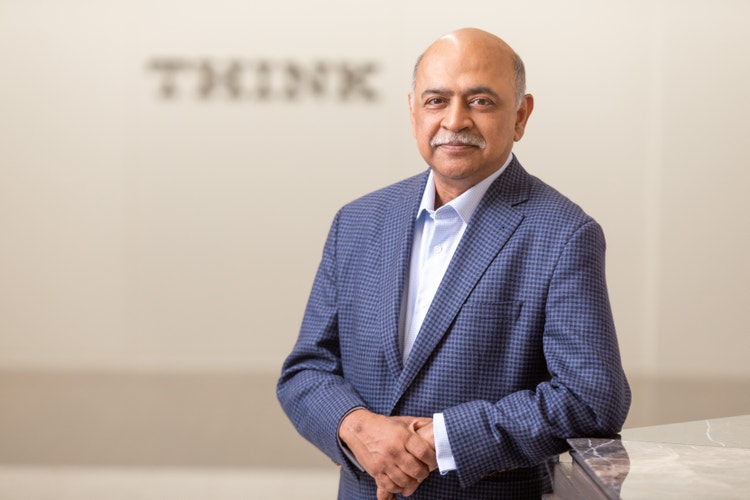
Today, about one-quarter of IBM’s revenue is “touched by partners someway or somehow,” Krishna told CRN, which translates to roughly $17 billion.
“I would like to see that fourth go to half,” he said. “But remember, as IBM goes up, that means probably our partner revenue has to become three times of what it is today. And that’s really what we would like to see.”
To unlock that milestone, IBM partners will need to play a sizable role in helping customers navigate AI, hybrid cloud, automation, security and data modernization as they bring a growing IBM software portfolio to market.
IBM sells direct to its top 1,000 customers and services the next 3,000 to 4,000 through partners with help from the company, Krishna said.
“And then there are the next 100,000, where we want to be largely partner-led as opposed to direct at all,” Krishna said. “That means that’s a good 30 percent of the overall opportunity. And, by the way, that’s where the maximum growth occurs because people graduate from there into the top category. Those are also the places where they don’t have that much expertise in-house, so they want expertise from a partner.”
Just as Armonk, N.Y.-based IBM has evolved throughout six years of Krishna's leadership to focus more intently on software, IBM’s message to partners is also evolving as Krishna looks to the channel to become a more significant route to market. With its partners, IBM wants to broaden the reach of offerings such as Red Hat, HashiCorp, Confluent, Apptio, Watsonx and hybrid cloud while claiming a larger share of the AI-driven transformation that is currently underway across the market.


When there is a moment of technology inflection like this, he said, it creates a “wonderful opportunity” for solution providers that lead with services.
“Once you get beyond a couple of 100 enterprises [in the world], who I’ll say are maybe capable of doing it themselves, everybody else is going to need help,” Krishna said. “‘Where do I deploy AI? Do I deploy it in enterprise [operations]? Do I make new applications? How do I unlock data? How do I get my data ready for this day of AI?’ There’s just an incredible opportunity for our services partners.”
The AI Catalyst
If the next group of 100,000 customers represents the channel’s IBM growth opportunity, AI will be the catalyst that helps partners reach it.
Four years after OpenAI released ChatGPT and ushered in the era of generative AI, Krishna said it’s time for the market to stop dabbling and start digging in.

‘People are experimenting a lot still [with AI], and my advice is it’s time to stop experimenting. Pick something and go try to get it done at scale.’
—Arvind Krishna, Chairman, President, CEO, IBM
“People are experimenting a lot still, and my advice is it’s time to stop experimenting,” Krishna said. “Pick something and go try to get it done at scale.”
The solution provider ecosystem must lean into its trusted adviser status with clients to avoid AI distractions, find the best-suited parts of the business for AI use cases and set up clients to avoid vendor lock-in and achieve flexibility, he said.
“Partners there can help our clients by saying, ‘Look, people, you need an ROI. Let’s focus in on one, two, three things where we can scale the answer so that it makes a real difference across the enterprise,’” Krishna said.
In aggregate, Krishna sees AI creating a 30 percent to 40 percent improvement in productivity for customers—maybe even a 10 to 20 times improvement at the extreme end.
Mechie Nkengla, CEO of Chicago-based solution provider Data Products, said her company has differentiated itself from other IBM solution providers by building a vendor-agnostic, consulting-led data and AI firm that combines strategy, governance, engineering and implementation, with goals to expand its international footprint, particularly in Europe and Africa.
The AI era has also opened up ways to sell beyond clients’ IT budgets and into human resources, finance, manufacturing and other functions within the organization, sometimes carrying their own budgets. “IT is always thought of as a cost center, so selling to the IT [organization] is usually a lot more cumbersome and time-consuming than selling to the functional, which is more thought of always as a revenue producer,” she said, noting that her work still involves client IT operations.
Data Products has also sought to speed up the piloting phase, getting away from three-month projects to shorter engagements when appropriate, giving four to six weeks to establish value in predetermined success metrics. Hitting those metrics leads to the next phase. Not hitting them leads to a session around what happened and deciding with the client to try again or walk away. “Let’s do something small, tenable, short, and show you what we can deliver before expanding,” she said. “It’s about building that trust.”
Downers Grove, Ill.-based Ensono—No. 73 on CRN’s 2026 Solution Provider 500 and an honoree on CRN’s 2026 MSP 500, is already grabbing the opportunity to dig deep into AI solutions.
Lisa Dyer, Ensono’s senior vice president of mainframe, said that at this point in the AI adoption cycle, clients are looking to more responsibly manage AI spending, giving the solution provider an opportunity in developing new services around AI operations (AIOps), which can also help prevent downtime.
Ensono is also investing in leveraging specialized AI models that understand COBOL and other programming languages for the platforms clients already run. Clients have turned to Ensono to make sure applications they still use after decades can scale with new technology adoption.
“It is absolutely part of the bigger picture,” she said. “Use [tools like Anthropic’s AI chatbot] Claude there where you can but use these specialized languages where you really need that understanding.”
IBM reported in April that its AI platform, agents, assistants and orchestration business had reached $1.5 billion in sales with only 25 percent market penetration. IBM’s AI business represented more than $4 billion in annual recurring revenue in its first fiscal quarter. IBM did not give updated numbers during its July quarterly earnings call.
Yet in Krishna’s point of view, AI is only the gateway to the opportunity. Customer conversations that might start with AI are increasingly expanding to include data readiness, security, infrastructure modernization and hybrid cloud initiatives, all areas where IBM’s broader software portfolio can play a role.
“Is it unlocking data for AI? I think Confluent is the world’s best answer to get that done,” he said. “Is it how do I protect myself in this day of cyberattacks? How do I do all my patching? Hashi is a great technology in both dimensions. Protect secrets with [HashiCorp] Vault, as well as leveraging for much more automated—I will use the word ‘AIOps’—for doing automation around how you manage all your infrastructure and code. Or is it about how do you begin to get a better sense of where you’re spending money and [where] is it most unlocked, which is Apptio?”
Krishna believes that solution providers can serve as a multiplier in the number of clients these products serve. “That is the big unlock that we have in front of us,” he said.
Confluent, a real-time data streaming platform provider IBM bought in March for $11 billion; HashiCorp, which IBM bought last year for $6.4 billion; and technology business management vendor Apptio, purchased by IBM in 2023 for $4.6 billion, are all seeing greater interest from clients, said David Luftig, executive vice president of strategy and innovation at Tallahassee, Fla.-based solution provider Pellera Technologies, No. 34 on CRN’s 2026 Solution Provider 500 and an honoree on CRN’s 2026 MSP 500.
“These are clearly industry-leading companies that IBM acquired, and it’s been a big piece of some of the lift with some of our clients,” he said. “We’ve seen strong growth with IBM.”
Wes Brown, CTO of Brentwood, Tenn.-based solution provider Arctiq—No. 80 on CRN’s 2026 Solution Provider 500 and a CRN 2026 MSP 500 honoree—said that IBM’s sharp eye for acquisitions has translated into multiple strengthened positions for partners.
Arctiq has seen more automation opportunities through IBM’s Red Hat enterprise-grade open-source software business and Red Hat’s Ansible division. The practice can complement the development life-cycle story with HashiCorp’s Terraform and then leveraging HashiCorp’s Vault for secrets management. And then the recent Confluent acquisition adds greater data telemetry muscle to partners’ toolboxes.

‘[IBM is] fulfilling their promise to acquire great, leading organizations and be able to tie those together. IBM collectively is doing all the right things there.’
—Wes Brown, CTO, Arctiq
IBM is “fulfilling their promise to acquire great, leading organizations and be able to tie those together,” Brown said. “IBM collectively is doing all the right things there.”
Solution providers also said they are growing their IBM cloud business.
Alex Talmor, president of Toronto-based GlassHouse Systems, said the solution provider has experienced more than tenfold growth in its IBM Cloud business over the past two years.
“We specialize in securing hybrid cloud environments for IBM. That’s our focus and niche,” he said. “What’s kept us busy is working with customers that are moving their environments to the IBM cloud.”
IBM’s Partner Program Plans
Leading the charge in evolving IBM’s channel partner program for the AI era is Channel Chief Kareem Yusuf, a 28-year veteran of Big Blue now in his second year as the vendor’s senior vice president, ecosystem, strategic partners and initiatives.
“My focus really remains building a vibrant ecosystem, a vibrant community of participants who are aligned around the common goal, and that common goal [is] extending our reach, really extending our value proposition and driving sustainable revenue growth,” Yusuf said.
To drive that vibrancy, Yusuf has pushed his team to build stronger alignment with IBM’s services-led channel partners.
“All our conversations with service partners start with, ‘What are you working on?’ We align to what their priorities are, not what we’ve got to push,” he said. “‘Oh, this is what you’re working on. OK, what from my inventory can I bring to bear? Let’s have a conversation.’”

‘My focus really remains building a vibrant ecosystem, a vibrant community of participants who are aligned around the common goal, and that common goal [is] extending our reach, really extending our value proposition and driving sustainable revenue growth.’
—Kareem Yusuf, SVP, Ecosystem, Strategic Partners, Initiatives, IBM
That change in mindset is strengthening the tie between IBM and its partners, he said.
“That, I think, has really shifted the whole dynamic because they now really see us as not trying to push something at them. We’re trying to actually support them in their objectives,” he said. “For us, we want them to positively influence the landing of our technology in their clients where it aligns with the problems that we think we’re suitable for.”
Another way Yusuf is driving that alignment is through the July 1 launch of Auto Deal Share. The opt-in feature aims to increase automation around lead sharing with qualified partners without manual touch, Yusuf said, noting that IBM is using a scoring system to ensure leads are being passed to partners that will actually make use of them.
“We have started that as a way to really increase deal velocity … and really to just remove friction as well as making sure our partners have the right access through the portal to also inform us about where the deal is [in terms of progress], so we’re both [getting] transparency,” he said.
To help existing partners and aid with the recruitment of new ones, Yusuf and his team have worked on improving automation between IBM’s systems and those of its value-added distributors.
IBM’s partner organization has also worked to help solution providers leveraging hyperscaler marketplaces to use customers’ committed spending with those vendors to speed up and simplify business, Yusuf said. He wants solution providers to see an IBM partner program that better differentiates incentives for partners based on their business models, with targeted resources for partners that embed IBM technology and other partner categories.
“We’re great people to partner with because the one thing I can promise anyone in our ecosystem is clarity,” Yusuf said. “I have committed to clarity and striving for simplicity, and you always know where I’m coming from. … And I’m always looking to further simplify and make [the partner experience] easier.”
Data Products’ Nkengla said she has found that the IBM partner program provides more resources and ways to differentiate compared with other vendor partner programs.

‘I really like the way they have their program support partners—significantly much more than other hyperscalers out there. What IBM is doing in terms of the partner support and building their ecosystem is phenomenal, and they should keep doing that.’
—Mechie Nkengla, CEO, Data Products
“I really like the way they have their program support partners—significantly much more than other hyperscalers out there,” Nkengla said. “What IBM is doing in terms of the partner support and building their ecosystem is phenomenal, and they should keep doing that.”
GlassHouse’s Talmor said he is pleased with the state of his IBM partnership, and his company is even in discussions to serve as a subcontractor on IBM projects.
Asked about where he’d like to see IBM’s partner investments go in the future, Talmor said he would like to see IBM sellers’ incentives more closely associated with partner success and wants more avenues for IBM, Red Hat and solution provider collaboration.
He would also like to see more cross-promotion and tighter integration across IBM and Red Hat as well as more visibility into IBM’s data security and quantum-safe capabilities.
But at a time when other vendors try to push too many partner program functions to their online portals and build more layers into their programs, he’s glad to see IBM emphasize white-glove service.
The IBM partner program is “really one of the best that I’ve seen that are available,” Talmor said. “They’re really trying hard.”
Hybrid Cloud, Red Hat Remain Critical Growth Engines
If IBM’s software strategy has a foundation, it is Red Hat.
Krishna sees Red Hat, hybrid cloud and open architecture as increasingly important as customers navigate rising AI costs, evolving infrastructure decisions and concerns about long-term vendor lock-in.
Eventually, hyperscalers and AI vendors that have spent billions on data centers to meet AI demand will need to recoup that investment, Krishna said.
Krishna predicts average AI usage prices will double in the next two to three years, with vendors getting that revenue not necessarily through licenses and end-user pricing, but through methods like ads in the tools and consumption caps.
“Given the unpredictability, doing a lock-in [with one vendor] is probably the worst decision that somebody can make, so keep flexibility and make sure that you can switch—I’m not going to say ‘painlessly’—but with an acceptable level of pain,” Krishna advised.
Data Products’ Nkengla said that the evolving AI costs will prompt an evaluation of the usefulness of the technology in workplaces. “It’s not an insignificant cost,” she said. “The cost is there. And so if you’re letting go of workers in lieu of the usage, of your credits for AI, at what point does the AI become more expensive than getting the human back in there?”
Although IBM missed revenue expectations last quarter, bringing in $17.2 billion instead of the $17.9 billion Wall Street forecast, Red Hat proved a bright spot. It grew 11 percent year on year—a 1-point acceleration quarter over quarter. Its OpenShift enterprise-grade container application platform reached annual recurring revenue of $2.2 billion.
Demand for containerization and virtualization products, with Red Hat solution providers playing a key role in migrating clients from legacy technology from Broadcom’s VMware, has led to $680 million in contracts signed since early 2024, IBM revealed during its most recent quarterly earnings.
IBM and Red Hat collaborated on a new Lightwell capability that aims to secure clients’ open-source software. Available as a $1-million-a-year subscription, Lightwell is part of a multibillion-dollar total addressable market and has put out 7,500 packages of remediations in its first two weeks of availability as a sign of strong early demand.
Pellera’s Luftig called the new software security initiative a big move that has caught client attention, with the solution provider’s Red Hat business growing as a recipient of virtualization migrations and other use cases. “We’re leaning in a lot with Red Hat, even as a stand-alone,” Luftig said.
Arctiq’s Brown said that the growing opportunity around Red Hat helped fuel the solution provider’s acquisition of Shadow-Soft in March.
Red Hat has been a beneficiary of the market upheaval created after Broadcom bought VMware in 2023. As a partner of both Red Hat and VMware as well as the major cloud vendors, Arctiq is helping customers navigate whether to leave VMware or stay, whether Red Hat is the better choice and whether customers should migrate workloads to pure cloud as VMware contract renewals approach.
“We saw some writing on the wall there with the hypervisor virtualization story,” Brown said of Red Hat. “We’re riding that wave.”
Red Hat has also proven a strong contender for helping clients get more use out of existing equipment given the lack of supply for components and memory that is currently plaguing the industry, the CTO said. OpenShift AI has also opened opportunities as a unified purchasing vehicle for users seeking high flexibility for AI model selection.
“Red Hat for us has been amazing,” Brown said. “In net-new conversations, it’s been really a strong leading topic for us.”
GlassHouse’s Talmor said that the VMware opportunity has not only put more attention on Red Hat but on IBM’s own enterprise-grade hypervisor offers. He’d like to see IBM invest more in its hypervisors’ capabilities, management, ease of use and operations to encourage more migration.
GlassHouse has been leveraging IBM plus other vendor partnerships to grow this side of the business.
“We have our own security managed services,” Talmor said. “We’re leveraging the fact that we’re managing critical applications, critical environments for the customer to be able to secure those.”
Data Products’ Nkengla commended IBM for investing in not just a full-stack technology approach across hardware, software, virtualization and FinOps, but in the ability to work with the various hyperscalers’ clouds and allowing users to access AI models from a variety of vendors, with that flexibility especially important for regulated industries.
“The governance is bar none, especially when you’re talking about industries that are sensitive in terms of regulations and compliance and risk at large,” she said. “And I love that. I think they should keep doing more of that.”
A Matter Of Trust
Much of Krishna's strategy ultimately comes down to trust: trust between customers and partners as well as trust between partners and IBM. As customers navigate AI adoption, shifting cloud strategies and growing security concerns, he sees an opportunity for IBM partners to deepen their role as trusted advisers while bringing a broader software portfolio to market.
At the same time, he said, solution providers can feel confident in the investments they are making in their IBM partnership.
“In this day, when technology is advancing, who do you want to trust? Who can stick with you for the next five to 10 years? Who has the investment wherewithal? Our history there of sticking to those patterns is important,” he said.