Data Center Market Share Face-Off: Hyperscalers Vs. Colocation Vs. Enterprise
“The world is racing towards a situation where hyperscale operators are responsible for the bulk of global data center capacity,” said Synergy Research Group’s John Dinsdale, explaining the current data center capacity market share.
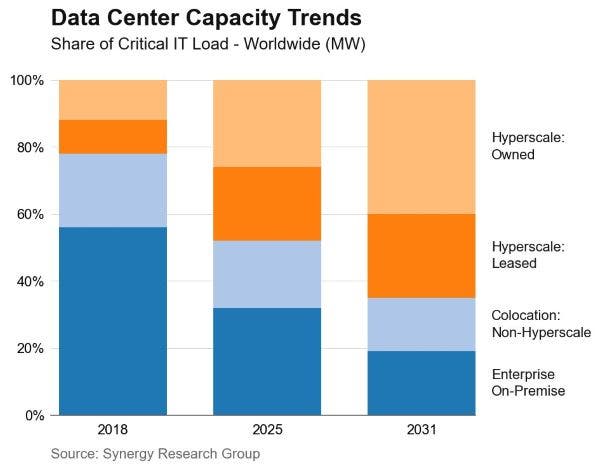
The global data center capacity market has shifted from being led by on-premise enterprises to now dominated by cloud hyperscalers, which currently own a whopping 1,360 large data centers.
In 2018, on-premise data centers for enterprises accounted for 56 percent share of all data center capacity. By the end of 2025, that market dropped to 32 percent share and is expected to fall to just 19 percent by 2031.
“But the reason is not that on-premise data center capacity is falling—it had been staying somewhat constant but is now receiving a boost from on-premise deployments of AI and GPU servers. The big change in the picture, of course, is hyperscale operators,” said John Dinsdale, chief analyst and research director for Synergy Research Group, in an email to CRN.
“In 2031 hyperscalers will have 14-times as much capacity in their data center footprint as they had back in 2018,” Dinsdale said. “The world is racing towards a situation where hyperscale operators are responsible for the bulk of global data center capacity.”
[Related: The 20 Hottest AI Cloud Companies In 2026]
CRN breaks down the data center market share comparing hyperscalers, non-hyperscale colocation, and enterprise on-premise data center total capacity as of the end of fourth quarter 2025, according to new data from Synergy Research Group.
2018 Data Center Capacity Share
Enterprise On‑Premise: 56 Percent
Colocation: 22 Percent
Hyperscale: 22 Percent
Hyperscale Leased: 10 Percent
Hyperscale Owned: 12 Percent
2025 Data Center Capacity Share
Enterprise On‑Premise: 32 Percent
Colocation: 20 Percent
Hyperscale: 48 Percent
Hyperscale Leased: 22 Percent
Hyperscale Owned: 26 Percent
2031 Data Center Capacity Share Estimate
Enterprise On‑Premise: 19 Percent
Colocation: 14 Percent
Hyperscale: 67 Percent
Hyperscale Leased: 27 Percent
Hyperscale Owned: 40 Percent
Data Center Capacity Trends Ahead; 800 Hyperscale Data Centers In Pipeline
Over the next five years, the total capacity of all data centers will continue to rise rapidly, driven primarily by hyperscale capacity growing more than threefold.
Hyperscalers are projected to control the majority of global data center capacity, with owned-hyperscale facilities becoming the single largest category.
“While colocation share of total capacity will slowly decrease, colocation capacity will continue to increase each year at near double-digit rates,” said Dinsdale.
After a sustained period of essentially no growth, on-premise data center capacity is receiving a boost thanks to GenAI applications and GPU infrastructure, he added.
Synergy said there are almost 800 hyperscale data centers in our known future pipeline, enabling hyperscale capacity to double in just three years.
Who Are Hyperscalers, Colocation And On-Premises Providers?
Hyperscalers include the largest cloud providers in the world such as Amazon Web Services, Microsoft and Google. These three companies are pouring billions of dollars each year into building and equipping large data centers that power their cloud and AI technologies.
Colocation providers include large technology infrastructure providers such as Equinix, Digital Realty, NTT Global Data Centers, CyrusOne and QTS. Many of these large colocation companies have dozens, in some cases hundreds, of data centers across the globe.
On-premises data centers are owned, hosted and managed directly by an organization within its own physical building or facilities. They do not rely on external cloud providers and typically own full control of the hardware, software and constant maintenance inside their on-premise data center.