How CrowdStrike’s Fal.Con Is Emerging As A ‘Mini-RSA’ For The Cyber Industry: Analysis
While Fal.Con 2026 remained unmistakably centered on CrowdStrike, its more than 10,000 attendees, expansive show floor and on-stage appearances by tech luminaries showed how the conference is evolving into a broader industry gathering.
For just about as long as the cybersecurity industry has been a thing, the list of annual conferences considered to be a must-attend has stayed fairly fixed.
But I’m thinking we may need to consider adding another one to the list—presently consisting of RSAC and Black Hat/DEF CON—after spending the week on-site at CrowdStrike’s Fal.Con 2026.
[Related: CrowdStrike SafeMind Gives Frontier AI To Defenders That Doesn’t Just Create ‘More Work:’ Partners]
Make no mistake—Fal.Con is still a showcase for all things CrowdStrike. But this year, the Las Vegas event was clearly something more than that.
A major turnout, expansive exhibition floor, speaker lineup featuring tech luminaries such as Nvidia CEO Jensen Huang—all of this made Fal.Con 2026 take on the feel of a more-compact RSAC.
In other words, I fully agree with George Kurtz, co-founder and CEO of CrowdStrike, who told media during a roundtable this week that with the 2026 edition of Fal.Con, the conference has turned into something of a “mini-RSA.”
Fal.Con “has really become an industry event,” he said—noting that it wasn’t just CrowdStrike partners out on the show floor this year. “We have competitors here,” he said.
For decades, RSAC has been the cybersecurity industry’s central annual gathering, and this year it drew more than 43,000 attendees and 600 exhibitors. Fal.Con 2026—which CrowdStrike said sold out in record time—drew 10,000-plus attendees and more than 150 sponsors to the Mandalay Bay convention center.
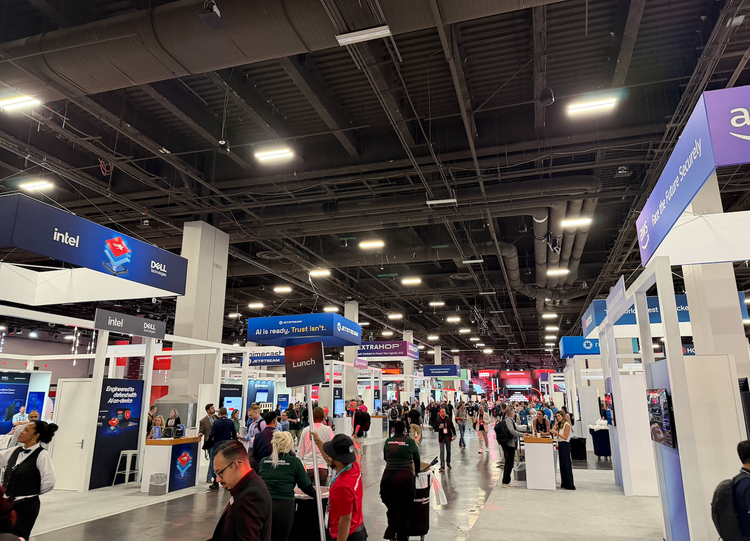
While its scale is not yet in striking distance (pun intended) of RSAC, many elements of this year’s Fal.Con nevertheless put it in a different category from your typical security vendor conference.
Out on the larger-than-usual expo floor, many exhibitors—including AWS, Fortinet and Zscaler—also had substantial booths that were closer in size to what you’d see at an RSAC or Black Hat.
Upon walking out onto the show floor for the first time this year, Kurtz said he had a reaction probably shared by many: “’Wow, I had no idea it was this big.’”
Even stronger evidence for the up-leveling of Fal.Con came on the main stage Tuesday. Kurtz’s keynote was followed by back-to-back discussions with Nvidia CEO Huang, Intel CEO Lip-Bu Tan and OpenAI co-founder and President Greg Brockman—three of the most prominent executives behind the ongoing AI revolution.
While the conversations certainly covered each company’s work with CrowdStrike, they extended into broader questions about the massive impacts AI is having on cybersecurity—and will increasingly have as both offense and defense becomes more automated.
Huang predicted that AI-powered attacks against companies will grow “exponentially,” making it ever more crucial to use the same technology to automate cyber defense. He also urged the cybersecurity community to counter what he described as excessive AI “doomerism.”
Tan, meanwhile, discussed the importance of protecting AI starting at the fundamental hardware layer—“security starts with the silicon,” he argued—and addressed the growing need for hardware-enabled guardrails.
As for Brockman, the OpenAI co-founder warned that cybersecurity teams are operating within a temporary “defender’s window,” where access to highly advanced AI capabilities is temporarily available to defenders before those technologies have spread broadly to threat actors.
Cybersecurity may need to undergo a transformation comparable to the changes that followed the emergence of the internet—but within just “six to 12 months,” Brockman said.
Without a doubt, the caliber of Fal.Con’s speaker lineup also reflects the rising profile of both CrowdStrike and the cybersecurity industry overall amid the AI boom.
AI has elevated security from a concern that predominantly mattered to CIO and CISOs, into an issue commanding the attention of CEOs and corporate boards, Bill Fryberger, principal and Americas cybersecurity advisory leader at EY, told me this week.
In the wake of disclosures of cyber models such as Anthropic’s Claude Mythos, CrowdStrike partners such as EY “weren’t talking to CIOs or CSOs—you’re talking to CEOs,” Fryberger said.
The expansion of Fal.Con has been organic, of course, Kurtz noted during the media roundtable.
“We didn’t sit here and go, ‘Hey, we want to have another RSA,’” Kurtz said. “But we wanted to put something together, in our CrowdStrike fashion, that was a lot of value for customers, in a curated manner.”
Much like both CrowdStrike and the cybersecurity industry itself, “it just grew.”