CRN Exclusive: NetApp's Lipsin On Hyper-Converged Plans And Navigating The Cisco Relationship

NetApp Plans Key Channel Role In Its Coming Hyper-Converged Infrastructure Rollout
NetApp, the storage industry's largest independent vendor, surprised the IT industry recently with plans to introduce its first real foray into the hyper-converged infrastructure (HCI) market using its SolidFire all-flash storage array as a base.
Given that the solution is still a few months away from formal introduction, NetApp has been stingy with details. SolidFire founder David Wright early this month discussed some of the technology related to the coming offering, but was unable to say much about the channel implications.
That task has fallen on Bill Lipsin, NetApp's vice president of worldwide channels, who shared some of his company's plans to make channel partners a critical part of its hyper-converged infrastructure technology roll-out.
For an in-depth look at some of the technology behind NetApp's HCI plans, see CRN's detailed conversation with Wright. For a look at how NetApp will tie HCI with converged infrastructure, or CI, turn the page.
CRN's Steve Burke and Jennifer Follett contributed to this story.
Tell us about NetApp's hyper-converged infrastructure plans.
We're coming, as you know, late to the market, just as we did with flash [storage]. With flash, we started off behind, in the number five market share position. We're number two now, and growing market share every quarter. The IDC numbers are extremely encouraging. So what we did was understand what the customer opportunities were, what the competition landscape was, and then we came up with something that was more than a 'me too.'
Expect the same sort of thing with HCI. [hyper-converged infrastructure]. It cannot be just a 'me-too' set of technologies or deliverables. But we're also going to be looking at this as more of a broader spectrum, a combination of HCI, so the hyper-converged, but also the converged infrastructure, the CI.

What part of the market will NetApp address?
There's that lower-end, where Nutanix has done a very good job, I believe, in penetrating. But there's the data center space that requires a different set of capabilities. That includes making sure that you're not locked into storage and compute upgrades at the same time, so, having more of a flexible capability in that area. Secondly, making sure that you leverage some of those capabilities that the NetApp technology provides that are unique, including ensuring that it's not just an HCI or CI conversation, but also locking into how you leverage the cloud. And making sure you can have your data being managed in private clouds, in hyperscalers, or on-prem. And moving that data all around.
This is not a traditional storage vendor type of a play. Instead, it's a data management capability that we're bringing to the table.

What's the gap you are seeing in the hyper-converged infrastructure market now?
The next-generation HCI that we believe NetApp is going to provide allows you to start getting into those tier-one applications in a much more robust fashion, by allowing you to make sure that you don't compromise performance as you start to have multiple tier-one workloads. That's one of those big gaps there, the whole quality of service of the applications.

How will NetApp's strategy differ from that of HPE or Dell EMC? They're also looking at how to link converged and hyper-converged infrastructure.
One of them is the fact that, with our strong data management capabilities that tie into the cloud, you do have the ability to move from disk to flash to the cloud, and have your data managed in all three of those areas. You're going to see that as one of the major differences. And it's the Data Fabric vision coming to reality more and more, as you've seen us doing over the last two years. So that'll be a big difference.
The second thing will be that the HCI and CI platform capabilities, a lot of it will be based on the SolidFire unique technologies that we acquired … such as guaranteed performance for multiple workloads. That's a huge one, and that's a unique. When you're looking at multiple workloads and ensuring that not one is taking away the capabilities of another, that's the kind of thing that the SolidFire technology provides that no one else does.

How does that differ from what established hyper-converged infrastructure vendors are offering?
It's those multiple workloads, tier-one workloads, that you're going to get [the capability for] from NetApp. It's not always bad being late to the market unless you're too late. That gives you a chance to understand what working, what's not working, and skip some of the lessons learned that others have had to pick up.
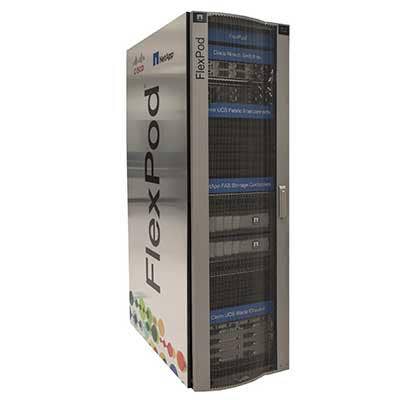
Cisco is a major partner of NetApp's in the FlexPod converged infrastructure offering. Is there any Cisco in NetApp's HCI solution?
In our HCI announcements that are upcoming, there's not a Cisco component that's part of that.
How do you navigate the Cisco relationship if you're still working with them on FlexPod without working with them on hyper-converged?
Probably the same way we're doing with [Cisco's] HyperFlex. There really are some distinct differences between the technologies and when you want to use them. That's been working pretty well. So far, the conflict between HyperFlex, the Cisco HCI solution, and FlexPod has been minimal … We've done a great job of saying, 'You have a number of choices to look at.' A lot of conversations may start with an HCI, that's what we've seen, and they turn into a converged infrastructure play, in this case, FlexPod.

What kind of time frame are we talking about?
Stay tuned … This will be a wild, blow-your-mind type of approach.
Any chance you'll be announcing this in June as part of the 25th-anniversary celebration of NetApp's founding?
That's another area we better make sure we're synced up with.… But you're right. That's going to be a major announcement in June for our 25 years in business. It's also going to be an announcement in terms of the narrative and vision of NetApp.

How will this roll out to the channel?
We've changed our new product introduction approach so that our channels know simultaneously if not before [our internal rollout].
What's your message to channel partners about getting ready for this?
It's not just getting ready, but also making sure that [we can answer when they ask], 'Give us the competitive analysis. Where do you fit with the others? Where do we put our emphasis? Which customers, which workloads are more [applicable] as a NetApp workload as opposed to somebody else in the marketplace?'

What will the distribution model be?
It will go through a two-tier distribution model. So we'll leverage all the elements that are in play in the industry today for HCI. Not re-create the wheel, but find unique capabilities that can leverage distribution [and] our solution providers in a fashion that gives the customers confidence that they're buying truly vetted HCI capabilities for tier-one workloads that allow them to leverage on-prem and cloud capabilities.
What distributors does NetApp work with?
Right now, we have two distributors in the U.S. and Canada. That's Tech Data, because of the Avnet TS acquisition, and Arrow.
Has the Tech Data-Avnet TS merger complicated things for NetApp at all?
No. Not at all. It's been well-managed and pretty seamless for us so far.

What are the services potential for partners?
One of the important pieces of feedback that we've had is that some of those HCI vendors, it's so easy to install [that] there are no services. And ours will be simple to install as well. But there are services that we believe solution providers can create, or already have, that we can start to fine-tune that really provide a value for the customer, including, 'When do I use HCI? When do I use CI? How does that tie into the overall hybrid cloud strategy?'
[And there are] those kind of trusted advisor roles that say, 'Let's understand all those technologies and what fits where? What should go in the remote office, branch office? What should go in the data center? How does it tie together? How do you manage that data? When do you use the cloud?'
So FlexPod continues as the hyper-converged infrastructure products are introduced, and solution providers have to figure out which is the best fit for customers?
FlexPod will be part of the solution. What we are doing is making sure we have clear positioning as to when would you use a NetApp HCI solution vs. a FlexPod-type solution?
How cut-and-dried are the use cases between HCI and CI?
There's actually a pretty clean cut when the workload should go on either one, depending on the types of workloads as well. There's a little bit of a gray area, especially in the VDI (virtual desktop infrastructure) side of the business …
[We will] make it as simple as possible for our partners to understand where the products fit because you will have an HCI, you will have a FlexPod, you'll have FlexPod with different flavors coming as well that might look a little more like an HCI solution. And then, of course, you've got your stand-alone products.
It's critical as you become more of a portfolio company that you can articulate what fits where and ensure that your channels can't get confused. It's not just with the competition but in your own portfolio.

Will there be new channel training and certifications for NetApp's hyper-converged infrastructure?
We're working through the total plan right now, which includes new training.
Will the typical NetApp channel partner, who has traditionally focused on storage, be able to deploy the company's hyper-converged infrastructure?
There's no reason why they couldn’t. But it really gets back to our rollout plan as to how you want to make sure when you bring this to market you get the maximum leverage from your solution providers. Some will want to invest with us to accelerate the NetApp solution. Those are the ones you should expect us to spend the most time with initially.

Are you counting on distributors to provide partner training on the services?
We're working close with the distributors right now to ensure that we've got optimum coverage. There are some solution providers that NetApp is very heavily involved in, that drive most of our partner revenue. There's a group of other solution providers that the distributors have a better relationship with and a more cost-effective way of handling them. So we're working together to make sure that we have a consistent way of delivering both enablement and support of all the partner ecosystem for NetApp.

Do you think HCI will bring new partners to NetApp?
It could bring new partners. I'm not sure that's a necessary part of the success formula. We've got an awful lot of good partners right now. It really [depends on] whether or not they want to be investing with NetApp to drive our market share approach.
We don't want to be just a 'me-too.' We want to make sure we have a plan for growing market share and growing it quickly.

Is there a big learning curve difference for services between NetApp's hyper-converged infrastructure offerings and other NetApp products?
One of the great things about being a little late to the market with HCI is [that partners already] have a level of comfort with HCI. What we're going to have to show them is a clear depiction of where the NetApp HCI fits versus the competition, and how our channel partners are going to determine how to weave that into the other product solutions we have.
I don't see that as a heavy lift. [The channel is] both the lift and also the accelerator that gets us into the kind of growth we're hoping for quickly.

How critical is the channel to NetApp's HCI plans?
First of all, NetApp's been a channel-centric company for a while. I think you've seen both an increased awareness and focus on the channel over the past two years that has resulted in increased sales through our channel partners, increased profitability for those channel partners who have followed the NetApp strategy in high-growth areas where we're succeeding in such as flash. But also, when you look at the success of the HCI vendors to date, they've worked very closely with the partner ecosystem.
We're going to be leveraging their experiences, but bringing them a new, unique value proposition that should allow them to grow even better and, I'd suggest, with a level of profitability for them, one that they haven't seen in the past in this area.
What kind of marketing support will NetApp put behind HCI?
That's a work in process right now.

How big of a game-changer is this for the NetApp channel and its profitability?
The value that [partners] can bring to customers gets back to understanding what the customer is trying to do, and then which one of the products inside our portfolio fits best. If it's a NetApp HCI solution, let's lead with that one. I'm going to guess that in a lot of cases it won't just be a NetApp HCI solution, but instead, it'll be, 'I need an HCI over here, I need a FlexPod over here, I need something else over here.' That provides not just a profitable conversation but goes back to the value proposition our solution providers bring: 'I'm not just pushing a box. I'm looking at what's best for your business. I'm going to bring you this capability with a portfolio of solutions. And in some cases, it will not include a NetApp product.' But that's the power of the channel.

How is NetApp coping with all those smaller startups who are hungry for NetApp's storage market share and point to NetApp as selling legacy technology?
I think some of those new startup companies are using old rhetoric. If all you do is look at the financial facts –not alternative facts, but financial facts – for the different companies over the last couple of quarters, you're going to see that some of the saber rattling is not quite as sharp as it used to be.
How so?
It's great to be in a position where we are showing growth. And the flash area, where we're showing not just strong double-digit growth but growing market share quarter over quarter, year over year, that starts to blunt some of the rhetoric you hear from some of those newer startup companies. The financial results that we're seeing, both if you look at ours in terms of cash and profit versus some of those other companies who are losing money, that also starts to reinforce that we're on the right path.
So, we're watching them. You don't want to take your eye off them. But we're spending more time ensuring that we're growing our areas of strength, and things are looking very positive.

What's going on with the channel from a competitive standpoint? You've got Dell EMC now trying to get more exclusive channel partnerships. HPE's always wanted to do that. Are partners going down that route?
HPE's tried this before. Others have tried this before: 'Come exclusive to us, and we'll give you more money.' And you have to listen because there's a lot of money involved. But it gets back to, what is it the customers are trying to get out of this? And I think they want something from different vendors that the solution providers pull together to solve that business problem.

Are NetApp partners looking at exclusive relationships?
We're getting feedback in terms of other vendors' programs and the richness of their offerings. And our partners are saying they're investigating. Nobody's moved over, that we can tell at this point. That's why we're looking at the last few months in the rear view mirror at how we're doing in terms of gaining market share, gaining increased partner revenue … and then making sure that we have an understanding of which partners want to invest with us, and working with them maybe a little bit closer to ensure that we're delivering something that takes into consideration what the other vendors are offering …
We've seen partners be successful with us, enjoy working with, like the predictability and the profitability. It starts to dull these programmatic conversations. So I'm feeling pretty positive right now.

Has NetApp finally moved customers past its legacy 7-Mode to the Clustered Data Ontap operating system?
That legacy strength we had in terms of the huge installed base in 7-Mode was both an asset and a challenge for us. We've pivoted past that now. I think the latest quarter's results actually articulated how much of the installed base now is on the new CDOT. That's important, because [it] allows us now to have that unique Data Fabric value proposition that was initially a concept, and then a piece of technology, and now actually an implementation tied into clouds and hyper-scalers. The momentum we're seeing there is going to continue to be an area that we're going to not focus on necessarily, but continue to reinforce and drive.

What is the next big fight for NetApp and its channel partners?
The areas that we're talking about now, such as HCI and CI, which are the new double-digit growth opportunities. That's where we have to ensure that we continue the market share growth and momentum we see in flash, tie the HCI piece into both that as well as the other double-digit area of growth we see, which is on the FlexPod side, and pull that together in a fashion for the technology that gives our partners some ability to go back to the customers and solve some true business problems.